The Personal Website of Mark W. Dawson

Containing His Articles, Observations, Thoughts, Meanderings,
and some would say Wisdom (and some would say not).
Simple and Complex Life’s Creation
Introduction
Much of my scientific knowledge is in the physical sciences, but I also have some understanding of other sciences. All of this knowledge has been acquired through autodidacticism, although I have read and researched extensively to gain it. I also have a deep curiosity about the major unanswered questions in science. In the life sciences, I am interested in the origin of how life was created and evolved, which I have discussed in my articles on The Rise of Intelligent Life and Intelligent Life in the Universe. This article addresses the mechanism of how simple life forms were created and then evolved into complex life, through the scientific theories of Abiogenesis and the Cambrian Explosion.
Abiogenesis
Abiogenesis is the scientific theory that life originated from non-living matter through natural processes, such as the combination of simple organic compounds. This theory suggests that simple organic molecules formed from inorganic substances, eventually leading to the emergence of simple life forms over billions of years. This process likely involved multiple stages of increasing complexity, ultimately leading to the emergence of the first simple life forms on Earth over 3.5 billion years ago.
Key Concepts in Abiogenesis
Stages of Abiogenesis
- Formation of a Habitable Planet: Earth developed conditions suitable for life.
- Prebiotic Synthesis: Simple organic molecules were created from inorganic compounds.
- Molecular Self-Replication: Molecules began to replicate themselves.
- Self-Assembly: Molecules organized into more complex structures.
- Emergence of Cell Membranes: Formation of boundaries that allowed for cellular functions.
Theories Supporting Abiogenesis
- Oparin-Haldane Theory: Proposed that organic molecules could form in a reducing atmosphere with energy sources like UV radiation.
- Miller-Urey Experiment: Demonstrated that amino acids could be synthesized from inorganic compounds under simulated early Earth conditions.
Environments for Abiogenesis
Potential Locations
- Deep Sea Hydrothermal Vents: These vents provide the necessary heat and chemical gradients for the formation of life.
- Terrestrial Hot Springs: Similar to hydrothermal vents, these environments may have supported early life.
Importance of Abiogenesis
Understanding abiogenesis is crucial for exploring how life began on Earth. It combines insights from biology, chemistry, and geology to explain the transition from non-life to life, a fundamental question in science.
The Cambrian Explosion
The Cambrian explosion was a significant event in Earth's history, occurring around 540 million years ago, marked by a rapid diversification of animal life and the appearance of most major animal groups in the fossil record. This period lasted approximately 13 to 25 million years and is considered a crucial phase in the evolution of complex life forms. This event saw the emergence of most major animal phyla, leading to complex ecosystems.
Key Features of the Cambrian Explosion
- Duration: The Cambrian explosion lasted about 13 to 25 million years.
- Biodiversity: Nearly all present-day animal phyla appeared during this time, including early chordates, arthropods, and mollusks.
- Fossil Record: The Burgess Shale in Canada is one of the most famous fossil sites from this period, showcasing a variety of life forms.
Causes of the Cambrian Explosion
Several factors contributed to this rapid diversification:
Environmental Changes
- Oxygen Levels: A small increase in atmospheric oxygen may have enabled the evolution of more complex life forms. This increase allowed for more efficient metabolism, supporting larger and more active animals.
- Habitat Availability: Rising sea levels created shallow marine environments, ideal for the development of diverse ecosystems.
Evolutionary Factors
- Genetic Innovations: The evolution of a "genetic toolkit" allowed for new body plans and developmental processes, facilitating rapid evolutionary experimentation.
- Predation: The emergence of predators likely triggered an evolutionary arms race, leading to the development of defensive adaptations among prey species.
Significance of the Cambrian Explosion
The Cambrian explosion is considered one of the most important events in the history of life on Earth. It set the stage for the evolution of complex life forms and established the foundational body plans that would dominate the animal kingdom for millions of years.
The Unanswered Questions
While much is known about Abiogenesis and the Cambrian explosion, there is still a lot to discover; and two fundamental questions remain unanswered.
- Although we understand the ingredients and environmental conditions necessary for life to originate, no scientific experiment has replicated these factors to produce a simple life form. This doesn't mean abiogenesis didn't happen; it only suggests our scientific knowledge might be incomplete. It’s also possible that a different scientific explanation better accounts for how life began on Earth.
- We are also unaware of any mechanism through which simple life could have mutated or combined to form complex life. Therefore, the key question is, by what process did simple life evolve into complex life? There is no scientific evidence explaining how this happened, but that is not surprising because such evidence was likely destroyed by geological forces over the millions of years since it occurred. Also, remember that absence of evidence is not evidence of absence. As a result, we may never scientifically know what the mechanism was or how it worked.
The importance of answering these questions is humorously pointed out in the following cartoon:
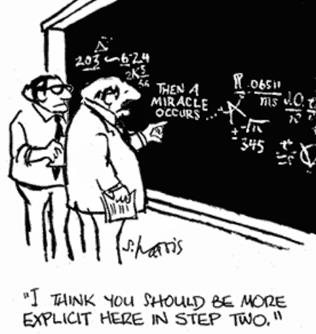
But discovery, asking questions, and answering questions are the core of science, as I have examined in my article On the Nature of Scientific Inquiry. Just because we don't have all the questions and answers now doesn’t mean they are unanswerable. Science is an ongoing process, and new discoveries often replace older scientific theories. Therefore, it is important that we do not jump to conclusions when science lacks answers and that we remain cautious about questions and answers in science, since Orthodoxy in Science, as well as Scientific Consensus and Settled Science, may be incorrect.
Disclaimer
Please note that my Science Articles disclaimer applies to this article, as it does to all of my science articles. These science articles are for the purposes of general scientific information that is understandable to a layperson, so that they can grasp the concepts of the topic being discussed. As such, they are neither as accurate nor as thorough as academics, scientists, engineers, and science writers strive to achieve. My hope is that these science articles will be informative and interesting, and that they will pique the reader's interest in exploring these topics in further detail via the hyperlinks that I have embedded into these articles.
If you have any comments, concerns, critiques, or suggestions I can be reached at mwd@profitpages.com.
I will review reasoned and intellectual correspondence, and it is possible that I can change my mind,
or at least update the content of this article.