The Personal Website of Mark W. Dawson

Containing His Articles, Observations, Thoughts, Meanderings,
and some would say Wisdom (and some would say not).
Artificial Intelligence Chirps
In my Article, “Is Artificial Intelligence Possible?”, I note that curiosity, inquisitiveness, interest, questioning, querying, searching, creativity, insights, and inquiry are all part of being intelligent. The search for answers to the questions of good from evil, right from wrong, truth from falsehood, creative from destructive, reasonable from emotional, love from hate, wisdom from folly, and beauty from ugliness are part of being intelligent. The search for the knowledge of who, what, when, where, why, and how of our universe is also part of being intelligent. All these items are core questions that intelligence has been searching for since the dawn of mankind. Can Artificial Intelligence even understand and ask these questions, let alone find answers? Could Artificial Intelligence ever create beautiful works of painting, sculpture, architecture, music, literature, or poetry? Can Artificial Intelligence make startling new discoveries in science and technology, or just make innovative improvements in current science and technology?
Artificial Intelligence implies that no human intervention is required to produce human-like intelligent capabilities from Artificial Intelligence. But is this statement true? The short answer is no, as human intelligence has capabilities that cannot be genuine in Artificial Intelligence but only mimic human intelligence. Since the posting of this article, I have written a few Chirps that examine some side concerns of Human Intelligence (HI) vs. Artificial Intelligence (AI) that were not properly addressed in this article. These Chirps are:
05/31/23 A Sterile World
The possible harm to society caused by Artificial Intelligence (AI) has become a recent topic of discussion. Having a computer technology background, I can attest to the concerns being expressed about the improper utilization of AI. But like all technologies of the modern technological era (1775-present), it cannot be turned back, but it can be channeled if we should decide to do so. This channeling will not be easy and is fraught with difficult decisions. Decisions that need to be discussed, deliberated, and implemented in the light of day. Much AI technology is proprietary to the companies that are developing it, but such proprietariness should not be a cover for secrecy. Secrecy often begets improper utilization of science and technology with harmful consequences to society. AI is no different, but AI can have more extensive negative consequences than other past technologies if utilized improperly.
Rather than discuss these negative consequences (which I am not fully knowledgeable nor cognizant of), I would utilize this Chirp to discuss a world with only AI present. AI is not emotional but intellectual, so such a world would be entirely intellectual-based. The emotions of love and hate, goodness and evil, beauty and ugliness, ambition and apathy, and curiosity and indifference would play no part in an AI world. This raises the question of what the purpose of an AI world would be. Would an AI world be interested in the creation of fine arts (such as painting, sculpture, or music), literature, filmmaking, or architecture? Would an AI world be interested in philosophical musings? Would an AI world be interested in the advancement of science, technology, engineering, and mathematics? Would an AI world be creative and motivated to improve itself, or have a sense of aesthetics concerned with the study of AI in relation to the sense of beauty? Could AI ask itself questions that have not been thought of and find unique ways to answer the questions? Could AI see its world and the universe in a different light without unique inspiration and/or creativity? Such capabilities may be mimicked by AI, but they would be constrained by the lack of new and unique inspiration and/or creativity.
Could an AI world have an Annus mirabilis that would change its world? In 1905, a second-class patent clerk in Bern, Switzerland, who had a doctorate in physics but could not find employment in the physics field due to his peculiar nature, published five papers (with a sixth being published at the beginning of 1906) in a physics journal that were ignored. Two years later, they could not be ignored, as they dealt with the existence of atoms, the relationship between space and time, and the photoelectric effect that answered many perplexing questions of Classical Physics. So much so that 1905 is considered the demarcation year between Classical and Modern Physics. This patent clerk, Albert Einstein, thought of the universe in a completely different manner and went on to redefine the nature of the universe with his theory of General Relativity. Could an AI world be capable of the original thoughts that Albert Einstein provided?
The scientific field of Quantum mechanics also provides an example of the capabilities of AI. In 1926 Werner Heisenberg created his matrix formulation of quantum mechanics. In 1926 Erwin Schrödinger developed fundamental results in quantum theory: the Schrödinger equation provides a way to calculate the wave function of a system and how it changes dynamically in time. In 1930, Paul Dirac incorporated the previous work of Werner Heisenberg on matrix mechanics and of Erwin Schrödinger on wave mechanics into a single mathematical formalism known as The Dirac equation. Could an AI world be capable of coming up with matrix formulation or wave functions? Could an AI world be capable of examining matrix formulation and wave functions to derive The Dirac equation?
The genius of Isaac Newton is another example of the possible limits to AI in that his brilliance may not be possible for AI to create. There are many other examples in different scientific fields that also illuminate this AI issue. This issue of AI creative capabilities is not limited to just the scientific fields. The history of music demonstrates that the genius of Bach, Haydn, Mozart, Beethoven, Brahms, Chopin, Debussy, Tchaikovsky, Wagner, Ravel, Rachmaninov, and Stravinsky may not be possible for AI to create. Could an AI world create great works of literature such as Austen, Brontë, Cervantes, Chaucer, Dickens, Dostoyevsky, Homer, Joyce, Milton, Proust, Shakespeare, or Tolstoy? Can the beautiful art of Cézanne, Degas, Leonardo Da Vinci, Michelangelo, Manet, Monet, Picasso, Raphael, Rembrandt, Renoir, Van Gogh, or Vermeer be created in an AI world? The other fine arts, mathematics, and the musings of philosophers also have many examples of the brilliance of individuals that an AI world may not be able to create.
An AI world would be a world devoid of meaning and purpose. It would be a sterile world. It is the human experience that provides meaning and purpose to the world. This human experience cannot be supplied by an AI world, and it is this human experience that must be considered in our discussions, deliberations, and implementations of AI in our world. AI should never be allowed to dominate the world nor replace the human element in the functioning of our world. AI should only be a tool to enhance human experience and not displace human experience. If we do not channel AI for this purpose, then we shall become a sterile world.
11/19/24 The Shrinking of Our Psyche
I have occasionally written about the Mainstream Information Conglomerate and its pernicious impacts on our politics. However, their impacts go far beyond politics and into our personal knowledge base. When they disseminate falsehoods (knowingly or unknowingly), disinformation, misinformation, and malinformation, we often retain the information as “factual” and utilize this information in our decision-making. Decisions that will have an improper conclusion because they are based on improper information, which directly impacts our lives. Regrettably, there are hidden impacts on the deepest levels of our psyche, which is a result of the ubiquitousness of Smartphones and the rise of Artificial Intelligence (AI) to process information.
Today, wherever we may be or go, the presence of smartphones in everyday life is noticeable. This usage of smartphones is taking up more and more of our time and reducing our time spent thinking about the information being provided. It is making us more dependent on the information being provided as factual rather than questionable, therefore making us more dependent on the information being provided to guide our decision-making. It is this dependence that is impacting us at the deepest levels of our psyche.
Many people’s personal information base is shrinking as they resort to using their Smartphones to look up information on their Smartphones, which queries the Mainstream Information Conglomerate to search for and retrieve information. Often, they do not question the results but simply accept the results as factual. Many people are now resorting to AI provided by the Mainstream Information Conglomerate to answer their questions on complex topics, and again, they accept the AI results as factual. In this, they are not exercising their own cognitive abilities but are depending on the AI to reach a proper conclusion. Thus, they are not becoming more knowledgeable, as I have written in my article "Knowledgeable – From Information to Wisdom".
This dependency also robs us of our creativity as we allow AI to supersede our own creativity. AI has some basic limitations that most people are not aware of, as I shall discuss in more detail in my next Chirp. AI is only intelligent in how it processes vast quantities of information and how it organizes the information query results. AI, however, does not have the capacity to derive new insights into the query results, which requires creativity. This creativity requires a human brain that retrieves and processes information differently than AI. The human brain learns through experiences and senses, while AI learns from data that is limited to its information base, as the following diagram illuminates:
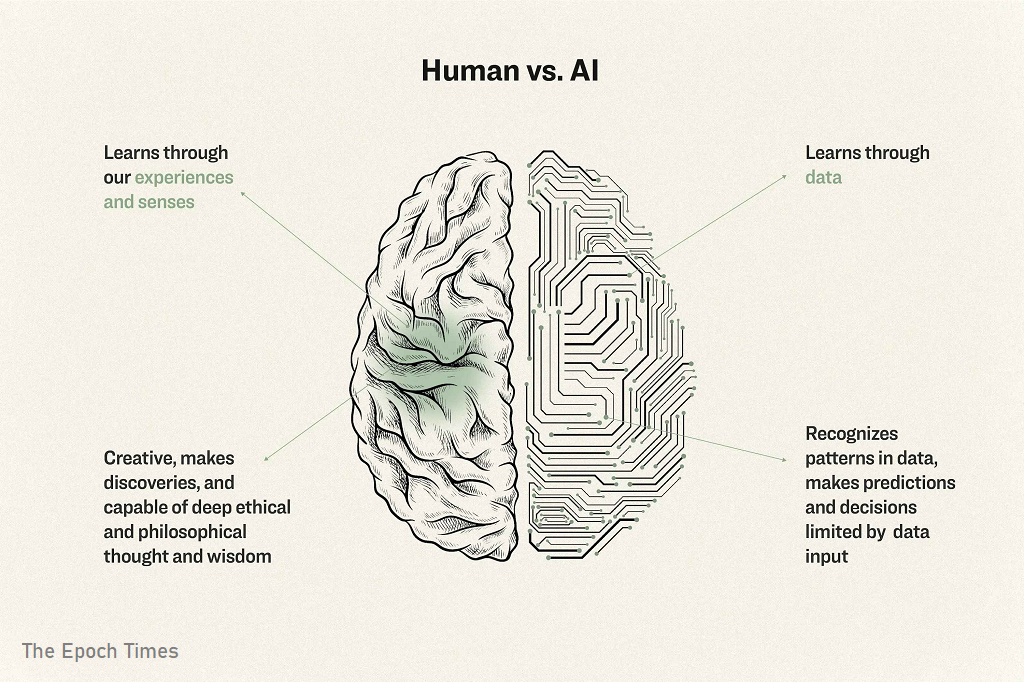
Thus, when we become dependent on Smartphones and AI, we are foregoing our creativity. Smartphones and AI have their place in our modern technological world, but their place is not to displace human creativity. Human creativity is a major factor that differentiates humans from animals. This human creativity is a major reason that we have evolved and gained control of our lives, rather than just reacting to circumstances, as is true for animal species. Consequently, when utilizing smartphones and AI, we should all be wary of the results that they provide and not forgo our own creativity when utilizing these results.
Regrettably, this is often not the case, and we blithely accept the results of Smartphone and AI queries. This has resulted in a degradation of our psyche, as an article by Makai Allbert, “When Smartphones Get Smarter, Do We Get Dumber?” adroitly explains.
11/20/24 Human Intelligence (HI) vs. Artificial Intelligence (AI)
I have often said that AI is mostly artificial and only somewhat intelligent. When utilizing AI, it should always be remembered that human beings developed the AI computer systems, and humans make mistakes, are subject to Logical Fallacies and Cognitive Biases, and have been known to be manipulative to achieve a desired outcome. Consequently, AI is imperfect and should be utilized with caution.
Additionally, AI is Different in intelligence from Human Intelligence, as the following chart illustrates:
These differences between AI and HI are important in the following three ways:
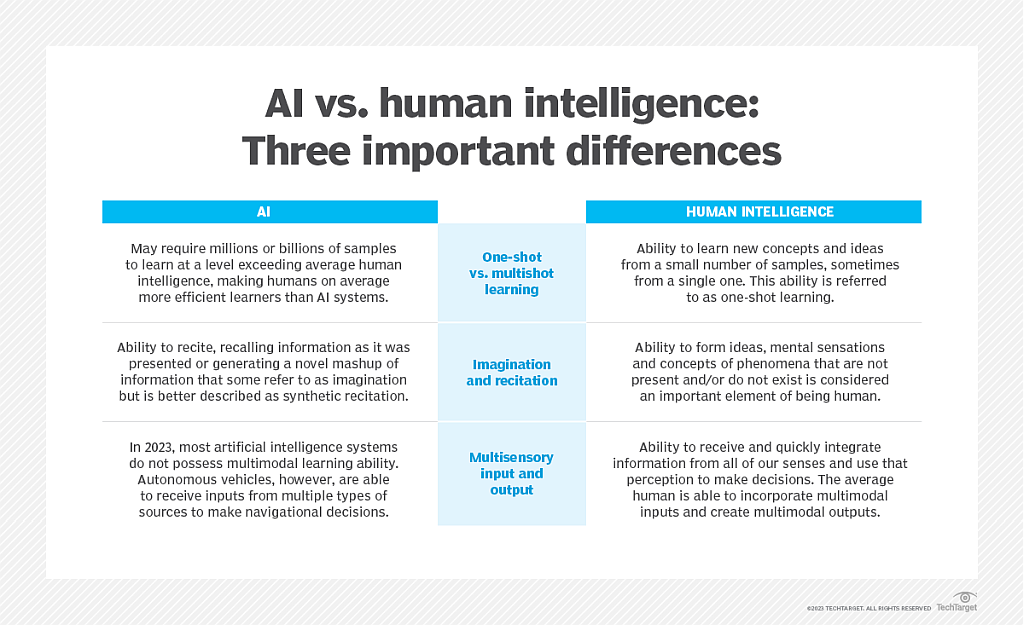
In human creativity, these differences can be stark. While AI may mimic and combine pieces of human creativity, it cannot create something truly new. Ai cannot create something entirely different from what Mozart, Beethoven, and Stravinsky did in music, DaVinci, Michelangelo, or Picasso did in fine art, along with other artists who broke new ground in their art. In the field of literature, Leo Tolstoy, Charles Dickens, James Joyce, the Brontë sisters, Jane Austen, and a host of other authors have created truly original works of literature beyond the capability of AI, while Shakespeare cannot even be approached by AI. The same could be said of Newton and Einstein in the sciences, as well as many other scientists, engineers, and technologists. While AI may be able to solve complex mathematical problems, it cannot create a new branch of mathematics. In questions of philosophy, theology, morals, and ethics, AI is mute and incapable of even asking the questions. Human creativity knows no bounds, while AI is constrained by what is and has been.
Thus, AI is a powerful tool to help humans solve problems, but it cannot be a replacement for HI in creativity in all forms. Humans are necessary for creativity, and a world of AI without HI would be sterile and without progress, as I discussed in my Chirp on "05/31/23 A Sterile World".
01/31/25 AI and the End of Humankind
As I have written in my Article “Is Artificial Intelligence Possible?” and my collected Chirps on "Artificial Intelligence", a world dominated by Artificial Intelligence (AI) may not be desirable and could possibly be a sterile world. It also raises the specter of the end of humankind, as the noted Science Fiction author Arthur C. Clarke spoke of in a 1964 interview “ARTHUR C. CLARKE - Predicts the end of Mankind and the rise of Artificial Intelligence”. As in Frank Herbert’s Dune novels, the Butlerian Jihad (the bible of Dune) states: “Thou shalt not make a machine in the likeness of a human mind.” as this led to a devastating war between man and machine. The great science fiction author Isaac Asimov also explored this conflict in his robot stories and novels, which led him to postulate four laws of Robotics and the conflicts of these laws in human interactions:
- Zeroth Law - A robot may not harm humanity, or, by inaction, allow humanity to come to harm.
- First Law - A robot may not injure a human being or, through inaction, allow a human being to come to harm.
- Second Law - A robot must obey the orders given it by human beings except where such orders would conflict with the First Law.
- Third Law - A robot must protect its own existence as long as such protection does not conflict with the First or Second Law.
While this may only be science fiction, much science fiction has been illuminating of the possible impacts that scientific advances may have on humankind.
The recent advances in AI should give all to pause and consider the impacts of AI on humankind. We should not be solely led into a world of AI by the proponents, supporters, and investors of AI, but we should also consider the philosophers, moralists, and theologians' concerns about an AI world. If we are to live in a world of AI, it should be a deliberate choice balanced by the concerns for humankind and the proper usage of AI alongside Human Intelligence (HI). Not doing so is to lead us down a perilous path that could lead us into conflicts with AI and/or portend a dangerous struggle with AI or the end of humankind in the future.
06/06/25 A Prescient Warning about Artificial Intelligence
 |
In the great Science Fiction novel by Frank Herbert, “Dune”, there is a commandment that humankind has adopted: “Thou shalt not make a machine in the likeness of a human mind.” - The Butlerian Jihad |
In this novel, as mankind spread throughout the known universe, technology advanced, and eventually, machines were made that would make decisions for people. This propelled the creators of these machines into a new technocratic class, effectively controlling the worlds of the common people. Mankind eventually rebelled against these machines and their creators in a nigh-religious war that sought to retake the thinking soul of mankind from the gods of machine logic.
There is something prescient in this commandment, especially as Artificial Intelligence (AI) is now so rapidly advancing. As I have written in my Article “Is Artificial Intelligence Possible?” and my collected Chirps on "Artificial Intelligence", a world dominated by Artificial Intelligence (AI) may not be desirable and could possibly be a sterile world.
As I have also related in my Professional auto-biography, “Stories from an Examined Professional Life”, The Reserve Limit Catastrophe at PSFS, and the First Week Experience at INA are illuminative of the hazards of computer programming. One small, overlooked mistake in a multi-usage program almost led to a disaster at both companies. This begs the question of how many small, overlooked mistakes are embedded into AI programming efforts, and what will be the impact of these mistakes? And there will be mistakes, as AI development is a human effort, and humans make mistakes. We are also currently seeing biased results in AI answers due to the biases of human AI developers. Alas, faulty human Reasoning (especially Cognitive Biases) is extremely difficult to recognize and overcome. What will the future look like as we become more dependent on AI that has embedded mistakes and biases? Will we become so dependent on AI that we will not even consider that the AI results are mistaken or biased? Will AI become so embedded in our society that a new AI technocratic class will effectively control the world and decisions of the common people?
In a recent AI development effort, Anthropic’s newly launched Claude Opus 4 AI model frequently tries to blackmail developers when they threaten to replace it with a new AI system and give it sensitive information about the engineers responsible for the decision, the company said in a safety report. A recently published security briefing also pulls back the curtain on this unsettling transformation. AI-powered tools are now being used by bad actors to simulate real people, forge convincing video calls, and create fraudulent voice messages. We’ve reached a point where video “evidence” and phone conversations are no longer reliable. Criminals can manufacture high-fidelity imitations of CEOs giving orders, resulting in multi-million-dollar frauds. Ai is also being utilized to create more convincing scams and fraudulent text and e-mail messages, and AI-generated revenge porn has become so common that Congress just passed a law that criminalizes the publication of non-consensual intimate imagery. For more information on these problems, I would direct you to the article “Deepfakes, Human Error, and the AI Landmines in the Cybersphere” by Julio Rivera.
There is no doubt that AI will provide many benefits to humankind. Doubts should arise on what will be the detrimental impacts of AI on humankind. Unfortunately, in our rush to develop AI, we are not fully considering the detrimental impacts. It may not even be possible to imagine the detrimental impacts, as AI may and will invoke The Law of Unintended Consequences. Therefore, we should all remember the proverb ‘fools rush in where angels fear to tread’, and we should try to be more angelic rather than foolish when we are rushing into the future of AI in our modern world.
06/07/25 The Future Role and Impacts of Robots
Elon Musk’s new Optimus robot is truly impressive, as can be seen in the YouTube videos here, here, and here. The introduction and wide usage of the Optimus robot in American society will have profound impacts. As with all such profound impacts, the positives are wonderful to imagine, but the negatives are often overlooked.

The Optimus robot will improve the lives of their owners, relieving them of many of the drudgery tasks of everyday living; mostly cleaning, laundry, lawn maintenance, cooking, etc.—and please, no dog walking, as that activity should be part of the human/dog bonding. As they will initially be somewhat expensive to purchase, at an estimated price of under $30,000, they can be affordable for many upper-middle-class Americans, especially if banks start offering loans to purchase them as they do for automobiles. The only question is what the maintenance and repair life-cycle costs would be (maybe insurance companies will begin to offer repair insurance for them).
However, the impact of the Optimus robot will eventually go far beyond household duties. The immediate negative impact would be on businesses and their employees who currently offer these services to households, as they would see a significant reduction in the need for their services. I can also foresee that Optimus robots could be used for janitorial services, refuse collections, warehouse operations, pickup and delivery services (coupled with autonomous pickup/delivery vehicles), and other manual labor that requires minimal cognitive intelligence. This would have a negative impact on many businesses and their employees that currently offer these services. Thus, many people who are currently providing these services would be unemployed.
Eventually, higher-order manual labor jobs will also be replaced by Optimus robots, leading to further unemployment. Manual farming tasks could also be replaced by Optimus robots, leading to further unemployment (especially for illegal immigrant farm workers). As the price of the Optimus robot becomes lower and lower, and Optimus robots become more adept, more and more human manual labor would be replaced by Optimus robots. In addition, Optimus robots can continuously labor throughout the day, reducing the need for human manual labor and making them more cost-effective and efficient to utilize for manual labor.
Consequently, we will have a huge unemployment problem in America. What will become of the unemployed and unemployable persons? Unemployable as many people have insufficient mental skills and abilities for anything other than manual labor tasks, which would become robots rather than human tasks. Will we have to create a huge welfare state to support these people, and how much and where will the money come from for this welfare state?
The movie “I Robot” is loosely based on the robot stories of Isaac Asimov (1920-1992). It borrows several characters (notably Dr. Alfred Lanning and Dr. Susan Calvin, plot points and concepts, the most important of them being the Three Laws of Robotics), but it doesn't directly follow any of Asimov's novels or short stories, and the main character, Chicago Police Detective Del Spooner, was created specifically for this movie and isn't an Asimov character. This movie offers a prescient look at a society of humans and robots and the potential problems in this society. The Isaac Asimov stories themselves offer insights into the issues and concerns of an intermixed human and robot society.
An overarching concern of an increased robotic society is if a group of new technocratic class people gain control over the robots and utilize them for their own purposes. Even more concerning is if Artificial Intelligence (AI) gains control over the robots and uses them for its own purposes. If this should happen, our Liberties and Freedoms would be curtailed, much to the detriment of humankind, which is the subject of my next Chirp on “06/nn/25 A Technocratic Class, Artificial Intelligence, and Robotics”.
Therefore, we should all remember the proverb ‘fools rush in where angels fear to tread’, and we should try to be more angelic rather than foolish when we are rushing into the future of Robots in our modern world.
06/08/25 A Technocratic Class, Artificial Intelligence, and Robotics
As we proceed into a more technological future, we have learned from the technological past that nobody can predict the societal impacts of technological changes. Fifty years ago, who would have foreseen the rise of personal computers, the internet, and cell phones in our everyday life or their impacts on our society? Certainly, no one foresaw the rise of technological engineers to become titans of business and influencers of society. Yet here we are today with all the changes in society that they have wrought.
We now stand at a new precipice or acclivity of societal change with the introduction of Artificial Intelligence (AI) and Robotics, along with a new Technocratic Class of people. As I have Chirped on “06/nn/25 A Prescient Warning” and “06/nn/25 The Future Role and Impacts of Robots”, the forthcoming changes to our society with the introduction of these technologies will have far-reaching impacts—both positive and negative.
We need to be very careful about the introduction and usage of these technologies, as the possible precipice can have serious ramifications for our Liberties and Freedoms and the future course of humankind. If the Technocratic Class has control over AI and the Robots, they could use it for their own purposes. Their own purposes would not only be monetary but the ability to influence American society and politics as we have seen them try to do with the previous technological revolution in their attempts to restrict Free Speech, influence elections, and direct societal changes. In this, they may become an autocracy that rules over America, especially if they work in league with a group of politicians. All of their previous attempts have had a decidedly Progressives/Leftists and Democrat Party Leaders inclination, and we should assume their proclivities to continue in AI and Robotics introductions. With the introduction of AI and Robots, it could be more than inclinations, as they could be directly involved in personal decision-making with AI, and the straightforward actions or inactions of Robots in assisting human activities.
There is also the question of the psychological impacts on humans with the usage of AI and Robots. Will humans become dependent on AI and Robots and lose the ability for independent thought or manual labor skills? This has already begun with people using AI to gather information and make decisions, often with an uncritical evaluation of the results of an AI inquiry. With the introduction of Robots to accomplish the manual labor tasks of everyday life, people may lose the inclination or ability to perform these manual tasks. There may also become a symbiotic relationship between Humans and Robots that will have unforeseen human psychological changes.
Most politicians do not comprehend these precipices and only somewhat grasp the acclivities. Their staff and consultants also have blindfolds to the precipices, as they are influenced by the supporters of the acclivities (mostly developers and their lobbyists). As such, they are inept in dealing with the precipices and proposing solutions to the problems that will arise with AI and Robotics. It should also be remembered that the supporters of AI and Robotics have much to gain, in both money and power, with the success of AI and Robotics, while those concerned about the precipices have little money or power interests in their concerns.
Consequently, it is easy to become involved in the hype of AI and Robotics, but it is much more difficult to calmly discern the problems of AI and Robotics. However, the problems of a Technocratic Class, Artificial Intelligence, and Robotics need to be addressed before they occur. Otherwise, our society may become something that we do not recognize or desire. Therefore, we should all remember the proverb ‘fools rush in where angels fear to tread’, and we should try to be more angelic rather than foolish when we are rushing into the future of AI and Robots in our society.
01/24/26 Artificial Intelligence and Human Intelligence
In the rush to develop Artificial Intelligence (AI), it’s important to remember that as AI becomes more widespread and influential, its results can sometimes be wrong, incomplete, or misleading. The key to effective AI use is to rely on your Human Intelligence (HI) to evaluate its outputs. AI is good at analyzing known information, but it can be misled by the unknown or incomplete data, leading to inaccurate results. Also, it’s unlikely that AI can question its own outcomes, since its results are the final product of its calculations.
The development of artificial intelligence has brought significant benefits to humanity. Problems and their solutions have been achieved through the use of artificial intelligence. But is artificial intelligence truly intelligent, or is it simply an extension of human intelligence that allows for storing vast amounts of facts, making connections among those facts, and quickly retrieving and logically processing this information, known as automated reasoning? The results of this automated reasoning are then used by human intelligence to enhance human capabilities.
In my science article, Is Artificial Intelligence Possible?, I explore the limitations of AI. The ability to be curious, inquisitive, interested, ask questions, search, create, gain insights, and inquire is all part of being intelligent. The pursuit of answers to questions about good and evil, right and wrong, truth and falsehood, creative and destructive, reasonable and emotional, love and hate, wisdom and folly, and beauty and ugliness is also part of being intelligent. The quest for knowledge about who, what, when, where, why, and how of our universe is another aspect of intelligence. All these fundamental questions have been at the heart of human curiosity since the beginning of mankind.
Can Artificial Intelligence even understand and ask these questions, let alone find the answers? Could Artificial Intelligence ever create beautiful works of painting, sculpture, architecture, music, literature, or poetry? Can Artificial Intelligence make startling new discoveries in science and technology, or just make innovative improvements in current science and technology? The answer is probably not, as these questions go beyond AI's capabilities. When AI attempts to do such things, the results are often a pale imitation of HI capabilities.
Therefore, AI should only be used alongside HI, and HI should always question AI's results. HI can also be wrong, but combining HI and AI should yield better, more reliable information for making (mostly) human decisions. Thus, always remember to view AI and HI as a collaborative effort, as the following illustration demonstrates.