The Personal Website of Mark W. Dawson

Containing His Articles, Observations, Thoughts, Meanderings,
and some would say Wisdom (and some would say not).
Is the Singularity a One-Time
Eruption?
Is the Singularity a One-Time Eruption?
In cosmology, the Big Bang Theory of the creation and expansion of the Universe became a scientific fact with the discovery of the Cosmic Microwave Background radiation. The Big Bang is a physical theory that describes how the Universe expanded from an initial state of high density and temperature. The notion of the Universe expanding at a calculable rate was first derived from the equations of general relativity in 1922 by Alexander Friedmann. Roman Catholic priest and physicist Georges Lemaître first proposed it as a physical theory in 1931, suggesting that the Universe emerged from a "primeval atom" and was expanding, based on Einstein's General Relativity. Edwin Hubble discovered in 1929 that galaxies are receding from us, with their speed increasing with distance, confirming the expansion of the Universe as Friedmann postulated and Lemaître theorized. This relationship is known as Hubble's Law, and Hubble’s Constant is the number that relates how fast a distant galaxy is receding to how far away it is, so it tells the current rate of the Universe’s expansion. Since that time, the primeval atom has been replaced by an eruption of a Gravitational Singularity, a condition in which gravity is predicted to be so intense that spacetime itself would break down catastrophically. It was from an eruption of a Gravitational Singularity that the Universe was created. As such, a Gravitational Singularity is, by definition, no longer part of regular spacetime and cannot be determined by "where" or "when". This eruption would also be only pure energy, with matter forming from interactions of that energy after it erupted from the Gravitational Singularity.
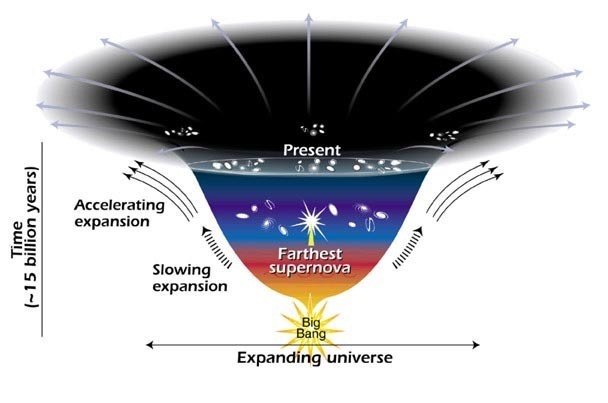
In the late 1990s, astrophysicists realized it would be possible to precisely measure the rate of expansion of the universe using space telescopes and supercomputers (again using Einstein’s General Relativity equations). At that time, they had three scenarios for the ultimate fate of the universe; a closed universe, an open universe, or a flat universe. A closed universe is one in which the mass of the universe is greater than the force of expansion, and the universe would collapse onto itself to create a new universe (the expansion of space, a stop, and then the contraction of space). An open universe is one in which the expansion is greater than the mass, and the universe will expand forever and eventually suffer total radioactive decay and cease to exist. A flat universe is one in which the mass and the expansion are equal, and the universe would stop expanding and remain fixed in size (nobody expected this result, but it was mathematically possible). Everybody expected that the rate of expansion was slowing, and we would end up in either an open or closed universe. To their surprise, the results showed that the rate of expansion was increasing. The only way this would be possible is if there were a repulsive energy force that was greater than the gravitational force. They named this energy “Dark Energy”. The astrophysicists went to the quantum physicists to ask what this Dark Energy could be, and the quantum physicists had no answer. Yet everyone agrees that Dark Energy exists, and until the Standard Model of particle physics can incorporate Dark Energy, it will be incomplete.
In my readings on the singularity, I realized there was an implicit presumption that it was a one-time event that ended after the initial eruption. But what if this presumption is not true? Is it possible that this singularity eruption is continuous? If it is continuous, is it erupting at the same rate, or at a faster or slower rate? If so, the Gravitational Singularity would still be adding primordial energy to the Universe. This additional energy could explain the Universe's accelerated expansion, as well as the Arrow of Time.
If more energy is being pumped into the Universe by a continuous Gravitational Singularity, then at some point the energy force would exceed the gravitational force, causing the expansion of the Universe to accelerate. This is what we have observed as a result of Dark Energy, as illustrated below:
As for the Arrow of Time, if we think of the present as the total amount of Energy and Matter in the Universe (N), then the past would be N Minus, and the future would be N Plus, as illustrated below:

Thus, the Arrow of Time is driven into the future by the singularity's continuous eruptions.
This would also resolve the paradoxes of time travel, as you could not travel to the past because the N- universes no longer exist, and you could not travel to the future because the N+ universe does not yet exist.
So ends my descent into this rabbit hole. I emerge, reminding you that I have no scientific bona fides to claim any science in this speculation. But it was fun speculation that set my creative juices afire. Please do not consider this speculation to have any scientific merit. Simply enjoy the flight of speculation, as this article was intended.
Disclaimer
Please note that my Science Articles disclaimer applies to this article, as it does to all of my science articles. These science articles are for the purposes of general scientific information that is understandable to a layperson, so that they can grasp the concepts of the topic being discussed. As such, they are neither as accurate nor as thorough as academics, scientists, engineers, and science writers strive to achieve. My hope is that these science articles will be informative and interesting, and that they will pique the reader's interest in exploring these topics in further detail via the hyperlinks that I have embedded into these articles.