The Personal Website of Mark W. Dawson

Containing His Articles, Observations, Thoughts, Meanderings,
and some would say Wisdom (and some would say not).
The Strangeness of Atomic Physics and
Quantum Mechanics
Atomic Physics
Atomic physics is the branch of physics that studies atoms as isolated systems, focusing on the structure of the atom, its energy states, and interactions with other particles. It primarily examines how electrons are arranged around the nucleus and how these arrangements change.
Key Concepts
- Atomic Structure: Atoms consist of a nucleus made of protons and neutrons, surrounded by electrons. The arrangement of these electrons is crucial for understanding chemical properties and reactions.
- Interactions: Atomic physics explores how atoms interact with photons and other particles, leading to processes like ionization and excitation.
Atomic Structure
An atom consists of a nucleus at its center, which contains protons (positively charged) and neutrons (neutral), surrounded by electrons (negatively charged) that orbit the nucleus in electron shells.
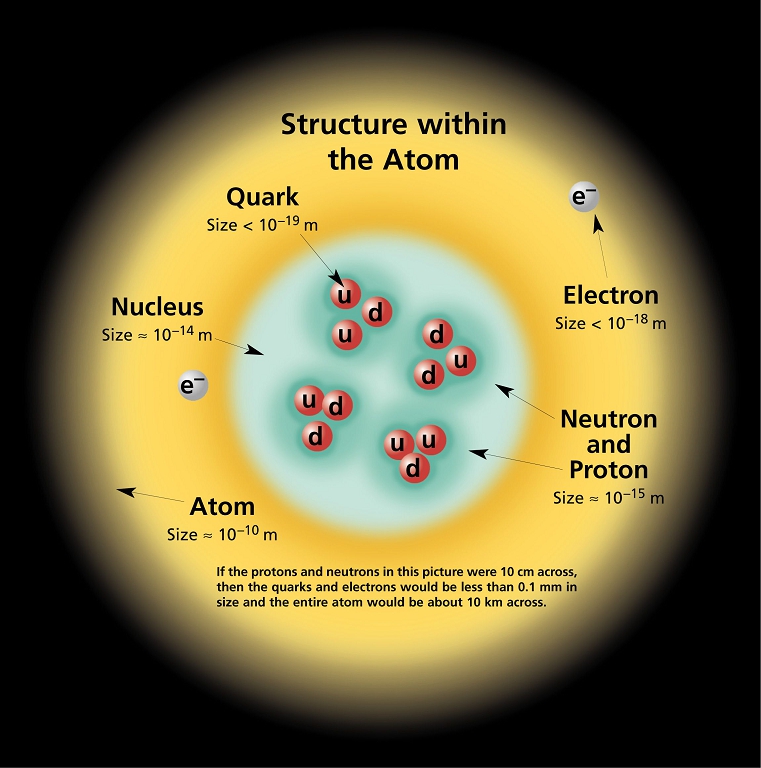
Overview of Atomic Structure
An atom is the smallest unit of matter that retains the properties of an element. It consists of two main regions: the nucleus and the electron cloud.
- Nucleus: Contains protons and neutrons. It is dense and holds most of the atom's mass.
- Electron Cloud: Surrounds the nucleus and contains electrons, which are much lighter than protons and neutrons.
Components of an Atom
|
Component |
Charge |
Location |
Mass (approx.) |
|
Protons |
+1 (positive) |
Nucleus |
1 atomic mass unit (amu) |
|
Neutrons |
0 (neutral) |
Nucleus |
1 amu |
|
Electrons |
-1 (negative) |
Electron cloud |
1/1836 amu |
Structure Within the Atom
Nucleus
The nucleus is the dense core of the atom, containing protons and neutrons. Protons determine the atomic number and identity of the element, while neutrons contribute to the atomic mass but do not affect the charge. Quarks are elementary particles and fundamental constituents of matter that combine to form protons and neutrons, which make up atomic nuclei.
The properties of the nucleus are:
- Size: The nucleus is much smaller than the entire atom, with a radius on the order of femtometers (10^-15 meters).
- Binding Forces: Protons and neutrons are held together by the strong nuclear force, which is significantly stronger than the electrostatic force that repels positively charged protons from each other.
- Quarks: There are six types of quarks, known as flavors: up, down, charm, strange, top, and bottom. Each flavor has distinct properties, including mass and charge.
Electron Configuration
Electrons orbit the nucleus in regions called electron shells. These shells can hold a specific number of electrons and are arranged in energy levels. The key features of electron shells are:
- Energy Levels: Electrons in higher energy levels are farther from the nucleus and have more energy.
- Orbitals: Electrons occupy orbitals, which are defined by their probability distributions around the nucleus.
Atomic Behavior
The behavior of an atom is determined by the arrangement and number of its subatomic particles:
- Protons: The number of protons defines the atomic number and determines the element's identity (e.g., hydrogen has 1 proton, while carbon has 6).
- Electrons: The arrangement of electrons in energy levels influences how atoms bond and interact chemically.
- Neutrons: Neutrons contribute to the atomic mass but do not affect the charge. Variations in the number of neutrons result in isotopes of the same element.
Forces Within the Atom
Strong Nuclear Force
The Strong Nuclear Force is one of the four fundamental forces in nature, alongside gravity, electromagnetism, and the weak nuclear force. It is crucial for the stability of atomic nuclei, as it binds protons and neutrons together.
Key Characteristics
- Strength: The strong nuclear force is the strongest of the four fundamental forces.
- Range: It operates over a very short distance, typically less than 3 femtometers (fm), which is about the size of a nucleus.
Functionality
Binding Particles
- Quarks: At the smallest scale, the strong force holds quarks together to form protons and neutrons.
- Nucleons: At a larger scale, it binds protons and neutrons (collectively known as nucleons) to form atomic nuclei.
Mechanism
- The strong force is mediated by particles called gluons, which act as the force carriers between quarks.
- At the level of nucleons, the force is transmitted through the exchange of mesons.
Importance in Physics
The strong nuclear force is essential for understanding nuclear reactions, such as fusion and fission, which are fundamental processes in stars and nuclear power. It also explains why atomic nuclei do not disintegrate despite the repulsive electromagnetic force between positively charged protons.
In summary, the strong nuclear force is vital for the structure of matter, enabling the existence of atoms and, consequently, all matter in the universe.
Weak Interaction Force
The Weak Interaction Force, also known as the weak force or weak nuclear force, is one of the four fundamental forces of nature. It plays a crucial role in various nuclear processes, including:
- Radioactive Decay: The weak force is responsible for the transformation of subatomic particles, such as the decay of neutrons into protons, electrons, and neutrinos.
- Nuclear Fusion: It facilitates the fusion of atomic nuclei, which powers stars, including our Sun.
Characteristics of the Weak Interaction
Distance and Strength
- Effective Range: The weak interaction operates at very short distances, typically less than the diameter of a proton (about meters).
- Relative Strength: Although termed "weak," it is significantly stronger than gravity at subatomic scales, being about times stronger than gravitational force within the nucleus.
Mediating Particles
The weak force is mediated by three types of bosons:
|
Boson Type |
Charge |
Role in Interaction |
|
W+ |
+1 |
Carries positive charge, involved in charged-current interactions |
|
W- |
-1 |
Carries negative charge, involved in charged-current interactions |
|
Z0 |
0 |
Neutral boson, involved in neutral-current interactions |
Importance in Particle Physics
The weak interaction is unique among the fundamental forces because it can change the type (or "flavor") of quarks, which are the building blocks of protons and neutrons. This ability to change quark types is essential for processes like beta decay, where a neutron is converted into a proton.
In summary, the weak interaction force is a fundamental aspect of particle physics, governing essential processes that shape the universe at the subatomic level.
Chemical Properties
Atoms can bond with one another to form molecules, which are the building blocks of matter. The way atoms bond is influenced by their electron configurations, particularly the outermost electrons, which are involved in chemical reactions.
Understanding atomic structure is fundamental to the study of chemistry, as it explains the properties and behaviors of different elements and compounds.
Atomic Interactions
Atomic interactions are the forces that occur between atoms, primarily driven by electromagnetic forces. These interactions are crucial for understanding how atoms bond and the resulting properties of matter.
Types of Forces
The main forces involved in atomic interactions include:
- Electromagnetic Force: This is the primary force at play, where charged particles (electrons and protons) either attract or repel each other.
- Strong Nuclear Force: While not directly involved in chemical bonding, this force holds protons and neutrons together in the nucleus. It is significantly stronger than the electromagnetic force but acts over very short distances.
Key Concepts
- Attraction and Repulsion:
- Like charges repel each other.
- Unlike charges attract each other.
- Electron Behavior:
- Electrons are often described as a cloud of electron density surrounding the nucleus, rather than as discrete particles moving in fixed orbits.
- Chemical Bonding:
- Atomic interactions are fundamental to the formation of chemical bonds, which determine the structure and properties of molecules.
Importance of Atomic Interactions
Understanding atomic interactions is essential for explaining:
- The behavior of elements and compounds.
- The physical and chemical properties of materials.
- The mechanisms of chemical reactions.
These interactions form the basis of chemistry and are vital for various applications in science and technology.
Historical Development
- Early Theories: The concept of atoms dates back to ancient Greek philosophers like Democritus. However, significant advancements began in the 17th century with scientists like John Dalton, who proposed that each element consists of identical atoms.
- Modern Models: The Bohr model, introduced by Niels Bohr in 1913, revolutionized atomic theory by describing quantized electron orbits. This model laid the groundwork for quantum mechanics and further developments in atomic and molecular physics.
Applications
Atomic physics has numerous applications, including:
- Chemistry: While chemistry is a separate field of science, and it was developed before Atomic Physics, modern chemistry has a foundation and is bound by Atomic Physics.
- Quantum Mechanics: It serves as a foundation for quantum mechanics, influencing fields like quantum chemistry and spectroscopy.
- Technology: Advances in atomic physics have led to the development of technologies such as atomic clocks, lasers, and various forms of spectroscopy.
Related Fields
Atomic physics is often studied alongside molecular and optical physics, which examine the interactions between light and matter at atomic and molecular levels. This interdisciplinary approach enhances our understanding of fundamental physical processes.
Atomic physics is fundamentally based on quantum mechanics, which describes the behavior of electrons in atoms using principles such as wave-particle duality, quantization, and the uncertainty principle. Quantum mechanics provides the framework for understanding atomic structure, including the arrangement of electrons in orbitals and the discrete energy levels they occupy.
Quantum Mechanics
Quantum Mechanics, also known as Quantum Physics, is the fundamental physical theory that describes the behavior of matter and light at atomic and subatomic scales. It explains phenomena that classical physics cannot, such as wave-particle duality and the probabilistic nature of particles.
Overview of Quantum Mechanics
Quantum mechanics is the science of the very small. It explains the behavior of matter and its interactions with energy on the scale of atoms and subatomic particles. By contrast, classical physics only explains matter and energy on a scale familiar to human experience, including the behavior of astronomical bodies such as the Moon. Classical physics is still used in much of modern science and technology. However, towards the end of the 19th century, scientists discovered phenomena in both the large (macro) and the small (micro) worlds that classical physics could not explain. The desire to resolve inconsistencies between observed phenomena and classical theory led to two major revolutions in physics that created a shift in the original scientific paradigm: the theory of relativity and the development of quantum mechanics.
Light behaves in some respects like particles and in other respects like waves. Matter—the "stuff" of the universe consisting of particles such as electrons and atoms—exhibits wavelike behavior too. Some light sources, such as neon lights, give off only certain frequencies of light. Quantum mechanics shows that light, along with all other forms of electromagnetic radiation, comes in discrete units, called photons, and predicts its energies, colors, and spectral intensities. A single photon is a quantum, or smallest observable amount, of the electromagnetic field because a partial photon has never been observed. More broadly, quantum mechanics shows that many quantities, such as angular momentum, that appeared continuous in the zoomed-out view of classical mechanics, turn out to be (at the small, zoomed-in scale of quantum mechanics) quantized. Angular momentum is required to take on one of a set of discrete allowable values, and since the gap between these values is so minute, the discontinuity is only apparent at the atomic level.
Many aspects of quantum mechanics are counterintuitive and can seem paradoxical, because they describe behavior quite different from that seen at larger length scales. In the words of quantum physicist Richard Feynman, quantum mechanics deals with "nature as She is – absurd". For example, the uncertainty principle of quantum mechanics means that the more closely one pins down one measurement (such as the position of a particle), the less accurate another measurement pertaining to the same particle (such as its momentum) must become.
For more information on Quantum Mechanics, I would direct you to the Wikipedia article on the Introduction to Quantum Mechanics.
Key Concepts of Quantum Mechanics
- Quantum Duality also known as wave-particle duality, is the concept in quantum mechanics that fundamental entities like photons and electrons exhibit both wave-like and particle-like properties depending on the experimental conditions. This duality challenges classical concepts, as these quantum objects cannot be fully described as just waves or particles.
- Quantum Entanglement is a phenomenon where particles remain connected and instantly affect each other's states, even when separated by large distances. This "spooky action at a distance," as Einstein called it, challenges classical physics and is a key feature of quantum mechanics.
- Quantum Superposition is a fundamental principle of quantum mechanics where a quantum system can exist in multiple states simultaneously until measured. This is often illustrated by the thought experiment of Schrödinger's cat, which is simultaneously both alive and dead.
- Quantum Transition is a change between different quantum phases of matter that occurs at absolute zero temperature, driven by quantum fluctuations rather than thermal fluctuations. This transition can be influenced by varying physical parameters like pressure or magnetic fields.
- Quantum Tunneling is a phenomenon where particles pass through potential energy barriers that they classically should not be able to surmount. This occurs due to the wave nature of particles, allowing for a non-zero probability of appearing on the other side of the barrier.
Symmetry and Conservation Laws in Quantum Mechanics
Noether's theorem is fundamental in quantum mechanics as it establishes a connection between Symmetries and Conservation Laws, similar to its role in classical physics. It allows physicists to derive conserved quantities from the symmetries of quantum systems, enhancing the understanding of their dynamics. By linking symmetries to conservation laws, Noether's theorem provides insights into the behavior of quantum systems, facilitating predictions about their evolution.
Overview of Symmetries and Conservation Laws
Conservation laws in physics state that certain measurable properties of an isolated system remain constant over time. Key examples include the conservation of energy, momentum, and angular momentum, which dictate that these quantities cannot change unless acted upon by external forces.
Symmetry in physics refers to the characteristics of physical systems that remain unchanged under specific transformations. These transformations can include rotations, reflections, and translations. The concept of symmetry is fundamental in understanding the laws of nature and plays a crucial role in various physical theories.
Noether's theorem highlights the relationship between symmetries and conserved quantities in Quantum Mechanics:
|
Symmetry Type |
Corresponding Conservation Law |
Definitions
- Conservation of Angular Momentum is a fundamental principle in physics stating that the total angular momentum of an isolated system remains constant if no external torque acts on it. This means that in the absence of external influences, the rotational motion of a system will not change.
- Conservation of Energy is a fundamental principle in physics stating that the total energy of an isolated system remains constant over time. Energy can be transformed from one form to another, but it cannot be created or destroyed.
- Conservation of Momentum is a principle in physics stating that the total momentum of a closed system remains constant if no external forces act on it. This means that in collisions or explosions, the total momentum before the event equals the total momentum after the event.
- Rotational Symmetry is the property of a shape that looks the same after being rotated by a certain angle less than a full turn. The number of times it matches itself during a full rotation is called the order of rotational symmetry.
- Space translation Symmetry refers to the property of a system where its laws or equations remain unchanged when the system is shifted in space. This means that the physical properties do not depend on the specific location in space, which is related to the conservation of momentum according to Noether's theorem.
- Time-translation Symmetry is a principle in physics stating that the laws of physics remain unchanged over time, meaning they are the same at any moment in history. This concept is important for understanding conservation laws and the behavior of physical systems.
Applications of Noether's theorem
Noether's theorem is widely applicable in:
- Classical Mechanics: It helps explain why certain quantities remain constant in motion.
- Quantum Field Theory: The theorem is essential for understanding the behavior of particles and fields.
- Statistical Mechanics: It provides insights into the conservation laws governing statistical systems.
Importance of Symmetry
Noether's theorem revolutionized the understanding of physical laws by showing that conservation laws are not arbitrary but arise from the symmetries of the laws governing physical systems. This insight has led to a deeper understanding of both classical and modern physics, influencing theories from mechanics to quantum physics.
In summary, Noether's theorem serves as a cornerstone of theoretical physics, linking the abstract concept of symmetry to tangible physical laws.
Conclusion
Atomic Physics and Quantum Mechanics are cornerstones of our modern technological world.
Atomic physics is crucial because it helps us understand the structure and behavior of atoms, which are the fundamental building blocks of matter. This knowledge is essential for advancements in technology, chemistry, and various scientific fields, influencing everything from medical imaging to the development of new materials.
Quantum Mechanics is the foundation for all electrical and electronic devices utilized in today’s world. Without Quantum Mechanics, the technology we utilize could not function properly. Our understanding of atomic and subatomic particles and processes is not possible without Quantum Mechanics. This is why Quantum Mechanics is a Fundamental Property of the Universe.
Please note that I wrote this Article with the help of my AI Search Assistance, as I am not sufficiently knowledgeable about this topic to write them myself. Much of the AI Search Assistance results are based on the Wikipedia article on these topics, which I have hyperlinked within these Articles and Chirps. However, I have edited the AI Search Assistance results for better readability, clarity, and understandability.
Disclaimer
Please note that my Science Articles disclaimer applies to this article, as it does to all of my science articles. These science articles are for the purposes of general scientific information that is understandable to a layperson, so that they can grasp the concepts of the topic being discussed. As such, they are neither as accurate nor as thorough as academics, scientists, engineers, and science writers strive to achieve. My hope is that these science articles will be informative and interesting, and that they will pique the reader's interest in exploring these topics in further detail via the hyperlinks that I have embedded into these articles.