The Personal Website of Mark W. Dawson

Containing His Articles, Observations, Thoughts, Meanderings,
and some would say Wisdom (and some would say not).
Islam Overview
Overview Of Islam
Islam is an Abrahamic monotheistic religion founded by the Prophet Muhammad in the 7th century CE in Mecca, Saudi Arabia. It is centered on the belief in one God (Allah) and the teachings of the Quran and the Hadith. It emphasizes submission to God's will and includes practices such as prayer, fasting, and charity, known as the Five Pillars of Islam. The term "Islam" means "submission" or "surrender" to the will of Allah, the Arabic word for God. Muslims, the followers of Islam, believe that Muhammad is the final prophet in a long line of prophets that includes figures like Adam, Noah, Abraham, Moses, and Jesus.
Core Beliefs Of Islam
The Prophet Muhammad
Muhammad (c. 570 – 8 June 632 CE) was an Arab religious, military and political leader, as well as the founder of Islam. According to Islam, he was a prophet who was divinely inspired to preach and confirm the monotheistic teachings of Adam, Noah, Abraham, Moses, Jesus, and other prophets. He is believed by Muslims to be the Seal of the Prophets, and along with the Quran, his teachings and normative examples form the basis for Islamic religious belief. No disrespect or blaspheming of Muhammad is permitted in Islam, and such people who do so are subject to a Fatwa in which they can be put to death or harshly punished.
The Oneness of God
- Tawhid: The principle of monotheism in Islam that emphasizes the belief in one God (Allah).
- Prophets: Muslims believe in many prophets, with Muhammad being the last. These prophets are individuals in Islam believed to have spread God's message on Earth and to serve as models of ideal human behavior.
Holy Books
The Quran and Hadith serve as a guide for all aspects of life, including moral, ethical, and social conduct.
The Five Pillars of Islam
These are the fundamental acts of worship and practice in Islam:
- Shahada Declaration of faith: "There is no god but Allah, and Muhammad is His messenger."
- Salat Ritual prayer performed five times a day.
- Zakat Almsgiving: giving a portion of wealth to the needy.
- Sawm Fasting during the month of Ramadan.
- Hajj Pilgrimage to Mecca, required once in a lifetime if able.
Saints In Islam
In Islam, the term "Wali" (plural: "Awliya") is commonly used to refer to saints, meaning "friends of God." These individuals are believed to be marked by divine favor and holiness, chosen by God, and often endowed with exceptional gifts, such as the ability to perform miracles. Sufi Saints in Islam are revered figures in Islam who are believed to have attained a high level of spirituality and closeness to God. They play a significant role in the spread of Islam and are often associated with miraculous abilities.
Criteria for Sainthood
Unlike the formal canonization process in Christianity, sainthood in Islam is not institutionalized. Saints are recognized based on their piety, moral character, and the positive impact they have on their communities. They are often revered for their extraordinary devotion to God and their exemplary lives.
Historical Context
The concept of saints became prominent during the rise of Sufism, a mystical branch of Islam. Early Sufi figures, such as Hasan of Basra and Rabia of Basra, are among the first recognized saints. The veneration of saints reached its peak from the 12th to the 14th centuries, with many saints being celebrated for their spiritual teachings and miracles.
Types of Saints
Islamic saints can include a diverse range of individuals, such as:
- Sufi Mystics: Spiritual leaders who guide followers on the mystical path.
- Companions of the Prophet: Close associates of Prophet Muhammad, revered for their contributions to Islam.
- Prophets: While all prophets are considered saints, they are not typically referred to as such to maintain their unique status.
Modern Perspectives
In contemporary times, the veneration of saints faces challenges from fundamentalist movements that reject traditional practices. However, many Muslims continue to honor saints as important figures in their spiritual lives, seeking their intercession and guidance.
Islamic Dietary Laws
Islamic dietary laws dictate what foods are permissible (halal) and forbidden (haram) for Muslims, based on guidelines from the Quran and the teachings of the Prophet Muhammad. Key prohibitions include pork, alcohol, and any meat not slaughtered according to Islamic methods.
Overview of Islamic Dietary Laws
Islamic dietary laws are guidelines that dictate what Muslims can and cannot eat. These laws are derived from the Quran and the teachings of the Prophet Muhammad. The terms used to classify food are:
- Halal: Permissible or lawful foods.
- Haram: Forbidden or unlawful foods.
- Mashbūh: Dubious foods, which are uncertain in their permissibility.
Halal Foods
Halal foods include:
- All fruits and vegetables
- Grains and cereals
- Meat from animals that are properly slaughtered (dhabiha)
- Seafood (with some exceptions in certain schools of thought)
For meat to be considered halal, it must be slaughtered by a Muslim or a Person of the Book (Christian or Jew) while invoking the name of Allah.
Haram Foods
Haram foods include:
|
Category |
Prohibited Items |
|
Pork |
All pork products, including bacon and gelatin |
|
Dead Meat |
Animals that died naturally or were not slaughtered according to Islamic law |
|
Blood |
Blood and its by-products |
|
Intoxicants |
Alcohol and any substances that cause intoxication |
|
Carnivorous Animals |
Meat from carnivores, such as dogs and cats |
Additional Concepts
- Makrooh: Discouraged foods that are not sinful but better to avoid.
- Darura: In cases of necessity, consuming haram food may be allowed to preserve life.
These dietary laws are essential for maintaining spiritual and physical well-being in the Muslim community.
Islamic Principles
Islamic Justice
Islamic law
Sharia, or Islamic law, meaning "the clear path" in Arabic, is the body of Islamic law derived from the Quran and the Hadith that governs various aspects of a Muslim's life, including moral conduct, family matters, and legal issues. It is interpreted differently across cultures and countries, resulting in a wide range of practices and applications, such as:
- Saudi Arabia: Full implementation in legal and social matters
- Iran: Comprehensive legal system based on Sharia
- Pakistan: Sharia influences family law and some criminal laws
- Indonesia: Regional application, primarily in family law
- Western countries: Limited to personal religious practices, often debated
Sources of Sharia
Sharia is based on four main sources:
- Quran: The holy book of Islam, considered the direct word of God.
- Hadith: The recorded sayings and actions of the Prophet Muhammad.
- Ijma: Consensus among Islamic scholars on legal issues.
- Qiyas: Analogical reasoning applied to derive legal rulings.
Key Components
Sharia covers various aspects of life, including:
- Ritual Practices: Daily prayers (Salat), almsgiving (Zakat), fasting during Ramadan, and pilgrimage (Hajj).
- Legal System: Governs personal, social, and economic matters, including family law, inheritance, and criminal justice.
- Ethical Guidelines: Emphasizes moral conduct and social justice.
Application of Sharia
Sharia covers various aspects of life, including:
- Rituals: Daily prayers, fasting during Ramadan, and pilgrimage to Mecca.
- Social dealings: Family law, business transactions, and ethical conduct.
- Criminal law: Divided into "hadd" (fixed punishments for serious crimes) and "tazir" discretionary punishments).
Sharia law is not exclusively Sunni or Shia; it is a body of Islamic law that both sects interpret differently.
Key Differences in Sharia Law
Sources of Law
|
Aspect |
Sunni Sharia Law |
Shia Sharia Law |
|
Primary Sources |
Quran, Sunnah (Hadith), Ijma (consensus), Qiyas (analogy) |
Quran, Sunnah (Hadith), Ijtihad (independent reasoning) |
|
Authority |
Consensus of scholars and community |
Authority of Imams, particularly in Twelver Shia belief |
Jurisprudence Schools
|
Aspect |
Sunni Schools |
Shia Schools |
|
Major Schools |
Hanafi, Maliki, Shafi'i, Hanbali |
Ja'fari (Twelver), Zaydi, Ismaili |
|
Legal Interpretation |
Based on established jurisprudence |
Emphasis on the teachings of Imams |
Legal Practices
|
Aspect |
Sunni Practices |
Shia Practices |
|
Marriage |
Allows up to four wives |
Allows up to four wives, but with stricter conditions |
|
Rituals |
Eid al-Fitr, Eid al-Adha |
Ashura, Arbaeen, in addition to Eid celebrations |
Sharia Law Conclusion
While both Sunni and Shia Muslims adhere to the fundamental tenets of Islam, their interpretations of Sharia law reflect their distinct historical and theological backgrounds. These differences influence various aspects of daily life, legal practices, and community governance within each branch.
Fatwas
Definition of Fatwa
A Fatwa is a legal ruling on a point of Islamic law (sharia) given by a qualified Islamic jurist (faqih) in response to a question posed by a private individual, judge or government. A jurist issuing fatwas is called a mufti, and the act of issuing fatwas is called ifta. It addresses specific questions posed by individuals or courts regarding various aspects of life, such as diet, finance, or family matters. While fatwas are considered authoritative, they are generally non-binding and serve as advisory opinions. Fatwas have played an important role throughout Islamic history, taking on new forms in the modern era.
Purpose and Importance
Fatwas play a crucial role in guiding Muslims on religious and daily life issues. They help clarify legal rulings and provide direction on new or complex matters that may not be explicitly covered in traditional texts. The issuance of fatwas allows for the adaptation of Islamic law to contemporary circumstances.
Types of Fatwas
Fatwas can be categorized based on their nature and implications:
- Obligatory Fatwa: Must be followed as it pertains to clear and binding issues.
- Recommended Fatwa: Suggests desirable actions but is not mandatory.
- Permissive Fatwa: Declares certain actions permissible under Islamic law.
Historical Context
Historically, fatwas have been significant in various contexts, including political and social issues. They have been used to legitimize government policies, address colonialism, and respond to contemporary challenges faced by Muslim communities. Notable fatwas have included those against Western colonialism and those addressing modern social issues.
Modern Role
In today's digital age, fatwas are more accessible, allowing for a higher volume of inquiries. They continue to evolve, reflecting the changing needs of Muslim societies while maintaining their foundational basis in the Quran and Sunnah.
Contemporary Perspectives of Islamic Justice
The interpretation and application of Sharia vary widely across different cultures and legal systems. Some Muslim-majority countries incorporate Sharia into their legal frameworks, while others adopt secular laws. The debate continues about its role in modern society, especially concerning human rights and sexual equality. Western civilization has many issues with Islamic justice, as it does not recognize individuals' Natural Rights and the Rule of Law (as I have written in my article on Justice and The Rule of Law in America), as understood in Western civilization.
Islamic Morality
Islamic morality is based on the teachings of the Quran and the Hadith, emphasizing virtues such as kindness, honesty, justice, and fulfilling promises. The ultimate aim of Islamic morality is to seek the pleasure of God and to live in accordance with divine guidance.
Foundations of Islamic Morality
Islamic morality is rooted in the belief in one God (Tawheed) and is guided by the Quran and the Hadith. These texts provide specific norms and codes of behavior that define what is considered right and wrong. The primary aim of Islamic morality is to achieve Raza-e Ilahi, or the Pleasure of God.
Key Principles
- Belief in God: Acknowledging God as the Creator and Sustainer is fundamental.
- Divine Guidance: The Quran and the teachings of Prophet Muhammad serve as moral guides.
- Accountability: Belief in the Hereafter emphasizes that individuals will be judged for their actions.
Common Moral Virtues
Islam promotes various virtues that are widely accepted across cultures. These include:
- Kindness to people and animals
- Charity and helping the needy
- Honesty and integrity
- Patience and perseverance
- Justice and fairness
- Respect for parents and elders
Contemporary Views on Morality
Most Muslims believe that morality is closely linked to faith in God. Surveys indicate that a significant majority across various countries assert that belief in God is essential for being a moral person.
Moral Issues
While there is consensus on many moral principles, opinions can vary on issues such as:
- Divorce and family planning
- Polygamy
- Attitudes towards alcohol and drugs
Islamic morality emphasizes the importance of good intentions and actions, asserting that both faith and good deeds are necessary for a righteous life.
Islam Ethics
Overview of Islamic Ethics
Islamic ethics refers to the philosophical reflection on moral conduct aimed at defining good character and achieving the pleasure of God. It is based on the teachings of the Qur'an and the practices of the Prophet Muhammad, emphasizing the importance of virtues and moral behavior in all aspects of life. It is distinct from Islamic morality, which focuses on specific norms or codes of behavior.
Key Principles of Islamic Ethics
Core Concepts
- Akhlaq: This term encompasses virtues, morality, and manners in Islamic theology. It emphasizes the practice of good character and ethical behavior.
- Adab: Refers to prescribed etiquette and good manners, promoting refinement and decency in interactions.
- Ihsan: Encourages excellence in all actions, whether in worship or daily life.
Fundamental Beliefs
- Tawheed (Oneness of God): Central to Islamic ethics, it emphasizes that all actions should align with the will of Allah.
- Adl (Justice): Justice is paramount, urging fairness in dealings with others.
- Intention (Niyyah): The intention behind actions is crucial in determining their moral value.
Application of Islamic Ethics
Islamic ethics guide behavior in various aspects of life, including:
|
Area |
Ethical Guidance |
|
Personal Conduct |
Perform acts of worship sincerely and adhere to teachings. |
|
Family Relationships |
Emphasize respect, love, and compassion towards family members. |
|
Business Dealings |
Conduct affairs with honesty and integrity, avoiding deceit. |
|
Societal Interactions |
Promote justice, equality, and support for marginalized groups. |
Ethics Conclusion
Islamic ethics provide a comprehensive framework for Muslims, guiding them in their daily lives to uphold virtues, justice, and compassion while striving to fulfill their ultimate purpose of worshiping Allah.
Islam Worship
Muslims worship Allah, the one God, through various acts such as the Five Pillars of Islam, which include prayer (Salah), fasting during Ramadan, and pilgrimage to Mecca. Worship in Islam is comprehensive, encompassing both ritual practices and everyday actions performed with the intention of pleasing God.
Understanding Worship in Islam
Definition of Worship
In Islam, worship (Ibadah and Ibadat) is a comprehensive concept that includes both ritualistic acts and everyday actions performed with the intention of pleasing God. It is not limited to formal rituals but encompasses all lawful actions done with God-consciousness.
The Purpose of Worship
Muslims believe that the primary purpose of human existence is to worship God. This belief is rooted in the Quran, which states that humanity was created to worship God. Worship fosters a connection with the Creator and is seen as a way to express love and submission.
The Five Pillars of Islam
The core practices of worship in Islam are encapsulated in the Five Pillars, which are essential for every Muslim:
|
Pillar |
Description |
|
Shahadah |
The declaration of faith, affirming that there is no god but God and Muhammad is His messenger. |
|
Salat |
Performing ritual prayers five times a day, facing Mecca. |
|
Zakat |
Giving a portion of wealth to those in need, typically 2.5% of annual savings. |
|
Sawm |
Fasting during the month of Ramadan from dawn until sunset. |
|
Hajj |
Undertaking a pilgrimage to Mecca at least once in a lifetime if financially and physically able. |
Rituals and Daily Life
Worship in Islam is not confined to mosques. Muslims can pray anywhere, and daily activities can also be acts of worship if performed with the right intention. This includes acts of kindness, honesty, and fulfilling one's responsibilities.
Worship in Islam is a holistic approach that integrates faith into every aspect of life, encouraging Muslims to maintain a constant awareness of God.
Islam Major Branches
The two main branches of Islam are Sunni and Shia, which differ primarily in beliefs about leadership succession after Muhammad's death. Sunnis make up the majority, while Shias are concentrated in countries like Iran and Iraq.
Sunni Islam
Overview of Sunni Islam
Sunni Islam is the largest branch of Islam, comprising approximately 85% to 90% of the global Muslim population, which translates to around 1.7 to 1.8 billion people. It is recognized as the mainstream and traditionalist branch, distinguishing itself from Shia Islam, which represents a minority. The name "Sunni" comes from "Ahl al-Sunnah," meaning "People of the Tradition," which refers to the practices and teachings of the Prophet Muhammad. Sunnis believe that after Muhammad's death in 632 CE, the leadership of the Muslim community should be determined by consensus rather than hereditary succession.
Key Beliefs
Succession to Muhammad
- Sunnis believe that Muhammad did not appoint a successor.
- They recognize Abu Bakr, Muhammad's close companion, as the first caliph.
- The first four caliphs, known as the Rashidun (Rightly
Guided), are:
- Abu Bakr (632–634)
- Umar (634–644)
- Uthman (644–656)
- Ali (656–661)
Sunni Islamic Law
Sunni Islamic law, known as Sharia, is derived from the Quran, Hadith (traditions of the Prophet Muhammad), and scholarly consensus (ijma). It encompasses various aspects of life, including rituals, ethics, and legal rulings, and is interpreted through four main schools of thought.
Sunni jurisprudence is based on several key sources:
- Quran: The holy book of Islam.
- Hadith: Recorded sayings and actions of Muhammad.
- Ijma: Consensus among scholars.
- Qiyas: Analogical reasoning.
The four main schools of Sunni Islamic law are:
- Hanafi: Hanafi is the largest school of Islamic jurisprudence within Sunni Islam, founded by the jurist Abu Hanifa. It emphasizes reasoning and derives legal principles from the Quran, the sayings of Muhammad, scholarly consensus, and analogical reasoning.
- Maliki: Maliki refers to one of the four major schools of Islamic jurisprudence within Sunni Islam, founded by Imam Malik ibn Anas in the 8th century. It emphasizes the practices of the people of Medina as a primary source for legal rulings, alongside the Quran and Hadith.
- Shafi'i: The Shafi'i school is one of the four major schools of Islamic jurisprudence within Sunni Islam, founded by the scholar al-Shafi'i in the 9th century. It emphasizes the importance of the Qur'an and Hadith as primary sources of law and is followed by millions of Muslims, particularly in regions like Southeast Asia and the Horn of Africa.
- Hanbali: Hanbali is one of the four major schools of Islamic jurisprudence within Sunni Islam, founded by Ahmad ibn Hanbal. It is known for its strict adherence to the Quran and Hadith, rejecting juristic discretion in favor of a literal interpretation of these texts.
Sunni Sharia law influences various aspects of life, including:
- Personal conduct: Guidelines for prayer, fasting, and charity.
- Family law: Marriage, divorce, and inheritance rules.
- Criminal law: Divided into "hadd" (fixed punishments) and "tazir" (discretionary punishments).
The application of Sharia Law varies widely across Muslim-majority countries. Some nations implement it fully, while others incorporate it into a mixed legal system alongside secular law. The debate continues regarding its role in modern governance, particularly concerning human rights and social justice.
Contemporary Sunni Islam
Sunni Islam has evolved over time, adapting to modern contexts while maintaining its core beliefs. The fall of the Ottoman Empire in the early 20th century marked significant changes, leading to the emergence of new political and religious movements, including Wahhabism and Salafism.
In recent years, Sunni communities have faced challenges, including sectarian conflicts and the rise of extremist groups. However, the majority of Sunnis continue to advocate for peace and coexistence within the broader Muslim community.
Shia Islam
Overview of Shia Islam
Shia Islam is the second-largest branch of Islam, comprising about 10-13% of the global Muslim population, which translates to approximately 200-260 million followers. The primary belief that distinguishes Shia Muslims is their conviction that Ali ibn Abi Talib, the cousin and son-in-law of the Prophet Muhammad, was designated as his rightful successor. This belief stems from the events following Muhammad's death, where a group of early Muslims chose Abu Bakr as the first caliph, leading to a significant schism.
Key Beliefs
Leadership and Imamate
Shia Muslims believe in the concept of Imamate, which holds that leadership should remain within the family of the Prophet Muhammad. They recognize a line of twelve Imams, starting with Ali and continuing through his descendants. These Imams are viewed as divinely appointed leaders with special knowledge and authority.
Major Branches
The three main branches of Shia Islam are:
|
Branch |
Description |
|
Twelverism |
The largest group, believing in twelve Imams, with Iran as a key center. |
|
Isma'ilism |
Recognizes seven Imams and has a significant presence in parts of South Asia. |
|
Zaydism |
A smaller group that acknowledges five Imams, primarily found in Yemen. |
Shia Islamic Law
Shia Islam derives its legal principles from four primary sources: the Quran, Sunnah (traditions of the Prophet Muhammad and the Imams), consensus (ijma), and reason (aql). These sources guide Shia scholars in interpreting and applying Islamic law within their communities.
Shia Islamic law, or Sharia, is derived from several key sources that guide legal and ethical practices. The primary sources include:
|
Source |
Description |
|
Quran |
The holy book of Islam, considered the direct word of God. |
|
Sunnah |
Traditions and practices of Prophet Muhammad, including sayings and actions. |
|
Ijma |
Consensus among scholars on legal issues, though used under specific conditions. |
|
Aql |
Reason or intellect, which is emphasized in deriving legal principles. |
In addition to the primary sources, Shia jurisprudence also utilizes secondary sources for legal rulings:
|
Source |
Description |
|
Ijtihad |
Independent reasoning by scholars to address new issues not covered in primary texts. |
|
Urf |
Local customs and practices that align with Islamic principles, recognized if not abrogated by the Quran or Sunnah. |
Shia Islam has its own unique school of thought, known as the Ja'fari school, which focuses on the teachings of the Imams. This school emphasizes:
- Reasoning guided by Imams: Legal interpretations are influenced by the teachings of the Imams, who are considered infallible leaders in Shia belief.
- Flexibility: The Ja'fari school allows for adaptability in legal rulings based on contemporary issues while maintaining core Islamic values.
These sources and principles form the foundation of Shia Islamic law, guiding the lives of its followers in various aspects, from personal conduct to social justice.
Historical Context
Shia Islam has faced persecution throughout history, particularly from Sunni-majority groups. Notable events include the martyrdom of Husayn, Ali's son, at the Battle of Karbala in 680 CE, which is a pivotal moment in Shia identity and commemorated annually during Muharram.
Contemporary Presence
Shia Muslims are predominantly found in countries like Iran, Iraq, and Azerbaijan, with significant communities in Lebanon, Kuwait, and Afghanistan. Iran is unique as it is the only country where Shia Islam is the state religion, influencing its laws and governance.
Muslim Peoples
Muslims are individuals who follow Islam, a monotheistic religion that originated in the 7th century CE with the Prophet Muhammad. They believe in one God, referred to as Allah, and consider the Quran to be the verbatim word of God as revealed to Muhammad.
Key Beliefs and Practices
Muslims adhere to five fundamental practices known as the Five Pillars of Islam:
- Shahada: The Shahada is the Islamic declaration of faith, stating, "There is no god but God, and Muhammad is the Messenger of God." It is one of the Five Pillars of Islam and is essential for anyone wishing to convert to Islam.
- Salat: Salat, also known as Salah or Namaz, is the Islamic practice of formal worship consisting of ritual prayers performed five times a day at prescribed times. It involves specific physical postures, recitations from the Quran, and is performed while facing the Kaaba in Mecca.
- Zakat: Zakat is a mandatory charitable contribution in Islam, representing one of the Five Pillars of the faith. It requires Muslims who meet certain wealth criteria to give 2.5% of their accumulated wealth to help those in need.
- Sawm: Sawm is the Arabic term for fasting in Islam, specifically during the month of Ramadan, where Muslims abstain from food, drink, and sexual relations from dawn until sunset. It is one of the five pillars of Islam and serves as a time for spiritual reflection, self-discipline, and increased devotion to Allah.
- Hajj: Hajj is an annual pilgrimage to the holy city of Mecca in Saudi Arabia, which is one of the five pillars of Islam. It is required for every Muslim to perform at least once in their lifetime if they are physically and financially able to do so.
In addition to these five pillars, Muslims also believe in prophets and angels, the Day of Judgment, and strictly follow the teachings of the Quran (Holy Book) and the Hadith (sayings of Muhammad).
Population and Distribution
Total Population
Islam is the second-largest religion in the world, with approximately 2 billion adherents, about 26% of the global population. It is widely practiced in regions such as the Middle East, North Africa, and Southeast Asia, with Indonesia having the largest Muslim population.
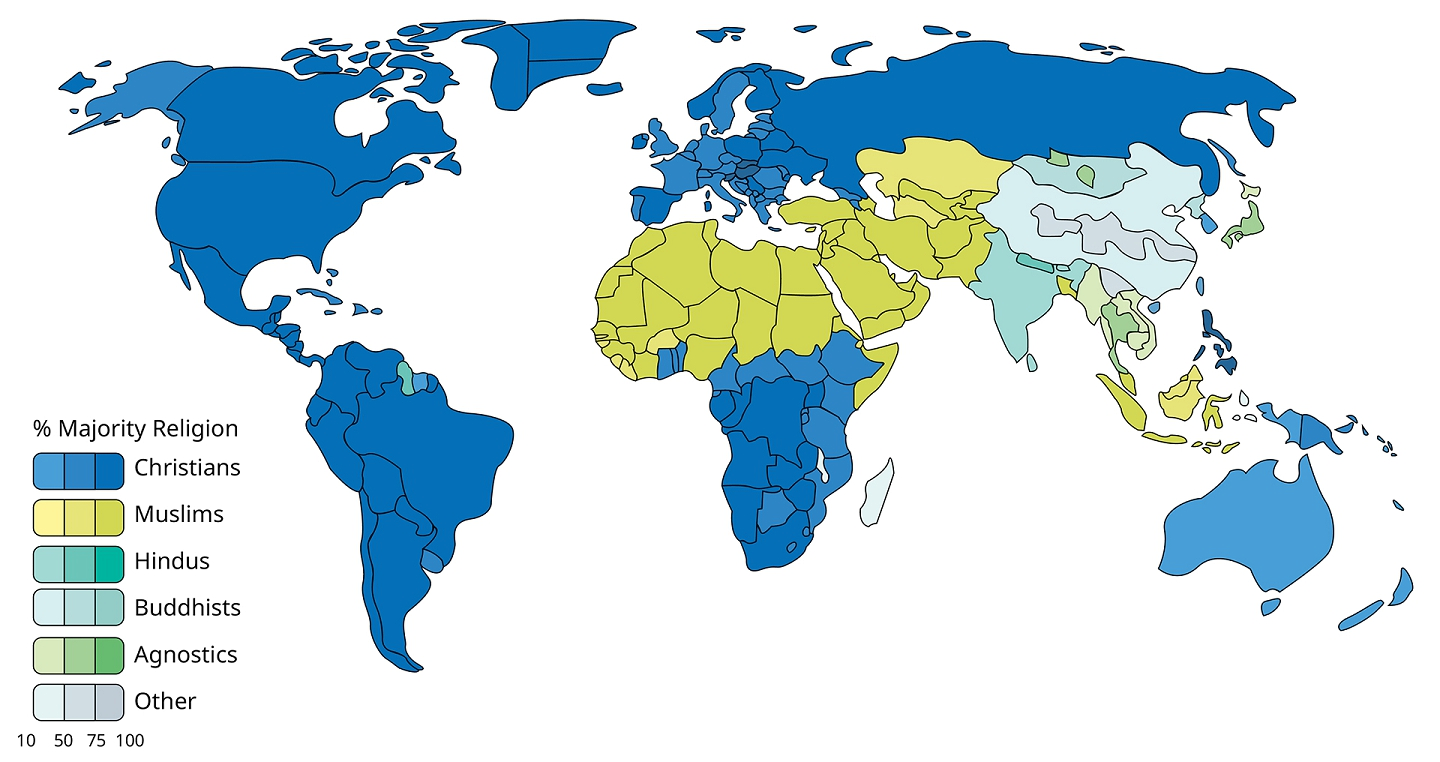
Muslim Demographics
Denominations
Islam has two primary branches:
- Sunni Islam: 87–90% of Muslims, 7 to 1.8 billion followers
- Shia Islam: 10–13% of Muslims, 200-260 million followers
Geographical Distribution
- Africa: 45%
- Asia and Oceania: 25%
- Europe: 6%
- Americas: 1%
As of 2020, there are 53 countries where Muslims constitute more than 50% of the population. Below is a list of some of these countries along with their estimated Muslim population percentages:
Overview of Regions
|
Region |
Muslims |
Muslim percentage (%) of total population |
Percentage (%) of World Muslim population |
|
World |
1,976,000,000 |
24.9 |
|
|
44,138,000 |
6.0 |
2.7 |
|
|
283,302,393 |
29.6 |
15.7 |
|
|
315,322,000– 488,603,838 |
91.2 |
27.1 |
|
|
240,000,000 |
40.0 |
13.3 |
|
|
600,000,000 |
31.4 |
30.6 |
|
|
1,100,000,000 |
23.3 |
66.7 |
|
|
54,000,000 |
81.0 |
3.0 |
|
|
550,000,000 |
47.0 |
30.6 |
|
|
3,500,000 – 7,000,000 |
1.0 |
0.4 |
|
|
791,000 |
0.2 |
0.04 |
|
|
650,000 |
1.6 |
0.04 |
|
|
50,000,000 |
3.1 |
2.8 |
Overview of Nations
|
Country |
Total |
Muslim |
% in |
% of World |
|
Maldives |
374,775 |
374,775 |
100 |
< 0.1 |
|
Mauritania |
4,161,925 |
4,157,425 |
99.9 |
0.2 |
|
Iran |
85,961,000 |
85,700,000 |
99.8 |
4.6 |
|
Somalia |
11,000,000 |
10,978,000 |
99.8 |
0.6 |
|
Afghanistan |
37,135,000 |
37,025,000 |
99.7 |
2 |
|
Djibouti |
1,003,800 |
998,273 |
99.4 |
0.1 |
|
Western Sahara |
603,253 |
599,633 |
99.4 |
< 0.1 |
|
Algeria |
44,178,884 |
43,737,096 |
99.0 |
2.7 |
|
Morocco |
36,738,229 |
36,370,847 |
99.0 |
2.1 |
|
Niger |
21,466,863 |
21,101,926 |
98.3 |
1 |
|
Comoros |
821,164 |
807,204 |
98.3 |
< 0.1 |
|
Tajikistan |
9,540,000 |
9,253,000 |
97.9 |
0.4 |
|
Tunisia |
11,446,300 |
10,190,000 |
97.8 |
0.6 |
|
Palestine |
4,780,978 |
4,298,000 |
97.5 |
0.3 |
|
Azerbaijan |
10,353,296 |
10,073,758 |
97.3 |
0.5 |
|
Yemen |
27,036,829 |
26,784,498 |
97.2 |
1.5 |
|
Senegal |
17,923,036 |
17,421,191 |
97.2 |
0.8 |
|
Jordan |
10,458,413 |
10,165,577 |
97.2 |
0.4 |
|
Libya |
6,754,507 |
6,551,871 |
97.0 |
0.4 |
|
Mayotte |
256,518 |
253,439 |
97.0 |
< 0.1 |
|
Pakistan |
241,500,000 |
233,000,000 |
96.5 |
11.79 |
|
Gambia |
2,413,403 |
2,283,080 |
96.4 |
0.1 |
|
Saudi Arabia |
34,220,000 |
31,535,000 |
96.2 |
1.8 |
|
Mali |
21,347,587 |
20,541,904 |
96.2 |
0.8 |
|
Sudan |
40,825,770 |
38,585,777 |
96.0 |
1.9 |
|
Iraq |
40,462,701 |
38,439,566 – 39,653,447 |
95.0 – 98.0 |
1.9 |
|
Turkmenistan |
6,031,187 |
5,610,000 |
93.7 |
0.3 |
|
Kosovo |
1,585,566 |
1,482,276 |
93.5 |
0.1 |
|
Turkey |
86,000,000 |
78,000,000 – 84,400,000 |
91.0 – 98.0 |
4.6 |
|
Bangladesh |
165,200,000 |
150,800,000 |
91.0 |
9.2 |
|
Egypt |
95,000,000 |
85,000,000 – 90,000,000 |
90.0 – 94.7 |
4.9 |
|
Guinea |
11,855,411 |
10,563,171 |
89.1 |
0.5 |
|
Uzbekistan |
34,036,800 |
29,920,000 |
88.7 |
1.7 |
|
Indonesia |
286,700,000 |
249,800,000 |
87.1 |
12.2 |
|
Syria |
18,000,000 |
15,000,000 |
87.0 |
1 |
|
Oman |
4,633,752 |
2,427,000 |
86.0 |
0.2 |
|
Brunei |
462,721 |
379,894 |
82.1 |
< 0.1 |
|
Kyrgyzstan |
6,500,000 |
5,200,000 – |
80.0 – 90.0 |
0.3 |
|
Sierra Leone |
7,719,729 |
6,067,706 |
78.6 |
0.3 |
|
Qatar |
2,450,285 |
1,566,786 |
77.5 |
0.1 |
|
Kuwait |
2,916,467 |
2,175,684 |
74.6 |
0.2 |
|
Bahrain |
1,501,635 |
1,111,533 |
74.0 |
< 0.1 |
|
United Arab Emirates |
9,541,615 |
6,251,627 |
72.0 |
0.2 |
|
Kazakhstan |
18,744,548 |
13,158,672 |
70.2 |
0.5 |
|
Lebanon |
5,261,372 |
3,567,211 |
67.8 |
0.2 |
|
Cocos (Keeling) Islands |
593 |
389 |
66.0 |
< 0.1 |
|
Burkina Faso |
21,382,659 |
13,513,840 |
63.8 |
0.6 |
|
Malaysia |
32,730,000 |
20,063,500 |
63.5 |
1.1 |
|
Chad |
15,833,116 |
9,183,207 |
58.0 |
0.4 |
|
Albania |
2,402,113 |
1,217,362 |
50.7 |
0.1 |
|
Bosnia and Herzegovina |
3,849,891 |
1,955,084 |
50.7 |
0.1 |
|
Nigeria |
200,000,000 |
95,000,000 – 97,000,000 |
47.0 – 49.0 |
5.3 |
|
Guinea-Bissau |
1,976,187 |
911,023 |
46.1 |
< 0.1 |
|
Ivory Coast |
26,260,582 |
11,265,789 |
42.9 |
0.5 |
|
Eritrea |
6,000,000 |
2,160,000 – |
36.0 – 51.6 |
0.1 |
|
Tanzania |
54,199,163 |
19,426,814 |
35.2 |
0.8 |
|
North Macedonia |
1,836,713 |
590,878 |
32.2 |
< 0.1 |
|
Ethiopia |
110,871,031 |
34,702,632 |
31.3 |
1.8 |
|
Cameroon |
25,640,965 |
7,692,289 |
30.0 |
0.4 |
These countries reflect the global distribution of Islam, which is the second-largest religion in the world.
Islamic Cultures
Islamic cultures refer to the diverse cultural practices that have developed among various peoples in the Muslim world. These cultures are influenced by Islam, but they also reflect a blend of local traditions of different ethnic and national backgrounds.
Islamic Holidays
Islam has two main holidays: Eid al-Fitr, which celebrates the end of Ramadan, and Eid al-Adha, which commemorates the willingness of Abraham to sacrifice his son. Both holidays are based on the lunar Islamic calendar and involve special prayers, feasting, and acts of charity.
Major Islamic Holidays
Eid al-Fitr
- Significance: Celebrates the end of Ramadan, a month of fasting.
- Observance: Begins with prayers on the morning of 1 Shawwal, followed by festive meals and giving to charity (zakat).
- Duration: Typically celebrated for one day, but festivities may last longer.
Eid al-Adha
- Significance: Commemorates the willingness of Ibrahim (Abraham) to sacrifice his son in obedience to God.
- Observance: Takes place on the 10th day of Dhu al-Hijjah, coinciding with the Hajj pilgrimage.
- Duration: Celebrated for 4 days, involving communal prayers and the sacrifice of an animal, with the meat shared among family, friends, and the needy.
Other Notable Days
- Ramadan: A month of fasting from dawn to sunset, focusing on prayer, reflection, and community.
- Islamic New Year: Marking the migration of Muhammad from Mecca to Medina.
- Ashura: Commemorating different events for Sunni and Shia Muslims.
Calendar Considerations
- The Islamic calendar is lunar, causing holidays to shift approximately 11 days earlier each year compared to the Gregorian calendar.
Key Elements of Islamic Culture
Cultural Practices
- Religious Influence: Many cultural practices are shaped by Islamic beliefs, but they can also include non-religious elements.
- Cultural Intermingling: Islam has facilitated the blending of cultures, creating a common Muslim identity across different regions.
Artistic Expressions
- Literature: Arabic literature, which includes poetry and prose, has roots in the 5th century and flourished during the Islamic Golden Age.
- Architecture: Islamic architecture features elements like domes, iwans, and intricate geometric designs. Notable examples include the Great Mosque of Samarra and the Alhambra.
Dance and Music
- Dance: Various forms of dance are integral to celebrations and cultural events, including folk dances and classical styles from different regions.
- Music: Music varies widely, with traditional forms often linked to specific cultures, such as Sufi music or regional folk styles.
Variations Across Regions
Islamic cultures are not monolithic; they vary significantly based on local traditions and historical influences. For example:
- Middle East: Arab traditions, Persian influences
- South Asia: Mughal and Persian artistic forms
- Southeast Asia: Local customs blended with Islamic practices
- North Africa: Berber and Arab cultural elements
These variations highlight the rich tapestry of Islamic cultures, shaped by both religion and local heritage.
Political Aspects of Islam
The Political aspects of Islam refer to how Islamic teachings and principles influence governance and political identity. The Political aspects of Islam are derived from its religious texts, primarily the Quran and Hadith, which guide the governance and social order within Islamic societies. This includes the intertwining of religion and state, as seen in historical contexts and modern movements advocating for political systems based on Islamic principles. This intertwining of religion and politics is a fundamental characteristic of Islam, contrasting with the separation of the State and Religion as seen in some other religions.
Forms of Governance
A caliphate is an institution or public office led by an Islamic steward with the title of caliph. This person is considered a political and religious successor to the Islamic prophet Muhammad and is considered a leader in the Muslim world. Historically, caliphates were political entities based on Islam that expanded into multi-ethnic, transnational empires. Some current Islamic countries have a parliament, while others are governed by an absolute monarch or dictator. However, these parliaments are often limited by Sharia law and the direction of the Caliphate, monarch, or dictator.
Overview of Islamic Government
Islamic government refers to a political system based on Islamic law (Sharia) and principles derived from the Quran and Sunnah. It aims to create a society that adheres to Islamic values and promotes justice, equity, and moral conduct.
Key Features of Islamic Government
Legislative Authority
- Divine Legislation: In an Islamic government, the authority to legislate belongs solely to God. Human leaders cannot create laws that contradict divine commandments.
- Role of the Jurist: The governance model often includes a jurist (faqih) who interprets Islamic law and guides the state in accordance with Sharia.
Objectives
- Social Justice: The primary goal is to ensure justice and protect the welfare of all citizens.
- Moral Development: Islamic governance emphasizes the moral and spiritual development of individuals, aiming to create a community that embodies Islamic values.
Historical Context
Early Islamic States
- The first Islamic state was established in Medina by the Prophet Muhammad, which served as a model for subsequent Islamic governance.
Modern Interpretations
- Various ideologues, including Ayatollah Khomeini, have articulated modern concepts of Islamic governance, emphasizing the integration of Islamic principles with contemporary political structures.
Conclusion
Islamic government is characterized by its foundation in divine law, its focus on justice and moral development, and its historical roots in early Islamic states. It seeks to create a society that aligns with Islamic teachings while addressing the needs of its citizens.
Key Concepts
Sources of Political Authority
- Quran: Contains verses that address legal and moral issues, with approximately 250-300 verses related to civil, criminal, and community affairs.
- Hadith: Accounts of the sayings and actions of the Prophet Muhammad, which provide additional context for governance.
Historical Context
- Prophet Muhammad: Became a political leader in Medina, establishing a model for governance that blends religious and political authority.
- Caliphate: Early Islamic governance was characterized by the leadership of the caliphs, who were seen as successors to Muhammad.
Modern Political Movements
Shia and Sunni Perspectives
- Shia Islam: The 1979 Iranian Revolution marked a significant shift towards political activism, emphasizing the role of Islam in governance.
- Sunni Islam: Generally has a more diverse approach to political authority, with various interpretations of governance.
Contemporary Issues
- Islamism: A political ideology that seeks to implement Islamic principles in governance, often leading to debates about the role of religion in state affairs.
- Political Islam: Refers to movements that advocate for a political identity based on Islamic principles, influencing various political agendas globally.
Conclusion
The political aspects of Islam are complex and multifaceted, shaped by historical contexts and contemporary movements. They continue to evolve, reflecting the dynamic relationship between faith and governance in Muslim societies.
Key Events in Islamic History
The Life of Muhammad
- Birth: Muhammad was born around 570 CE into the Quraish tribe, a powerful merchant family in Mecca.
- Revelations: At age 40, he began receiving divine messages, which he preached to others.
- Hijra: In 622 CE, facing persecution, Muhammad and his followers migrated to Medina, marking the start of the Islamic calendar.
Spread of Islam
- Conquests: Following Muhammad's death in 632 CE, Islam spread rapidly across the Arabian Peninsula through military conquests and trade.
- Caliphates: The Ali, Umayyad and Abbasid Caliphates played significant roles in expanding Islamic territory and influence, reaching as far as Spain in the west and India in the east by the 8th century.
8th to 10th Century
- Umayyad Caliphate Expansion (661-750): The Umayyad Caliphate expanded significantly, reaching from Spain (al-Andalus) to the Indus River. This period saw the establishment of major Islamic cities and trade routes.
- Abbasid Revolution (750): The Abbasids overthrew the Umayyads, moving the capital to Baghdad, which became a cultural and intellectual center.
11th to 13th Century
- Islamic Golden Age (8th-14th Century): This era was marked by advancements in science, mathematics, medicine, and philosophy. Notable scholars emerged, contributing to various fields.
- Crusades (1096-1291): A series of religious wars initiated by European Christians aimed at reclaiming the Holy Land from Muslim control, leading to significant conflict and cultural exchanges.
14th to 16th Century
- Mongol Invasions (13th Century): The Mongol invasions led to the establishment of Islamic empires like the Ilkhanate, which spread Islam in Persia and beyond.
- Ottoman Empire Rise (1299): The Ottomans began their expansion, eventually controlling vast territories in Europe, Asia, and Africa, becoming a major Islamic power.
17th to 19th Century
- Decline of the Ottoman Empire (18th-19th Century): The empire faced internal strife and external pressures, leading to its gradual decline.
- Colonialism: European powers colonized many Muslim-majority regions, significantly impacting Islamic societies and governance.
20th Century to Present
- Post-Colonial Era: Many Muslim countries gained independence, leading to the establishment of new nations and political movements.
- Islamic Revival Movements: The late 20th century saw a resurgence of Islamic identity and political movements, influencing global politics.
Criticism of Islam
Overview of Criticism of Islam
Criticism of Islam can take various forms, including academic, political, and personal opinions, often focusing on Islamic beliefs, practices, and historical actions. Common points of criticism include the life of Muhammad, the authenticity of Islamic scriptures, and issues related to human rights and gender equality within Muslim-majority societies.
Key Areas of Criticism
Historical Context
- Early criticisms emerged from Jews and Christians during Islam's formative years.
- Post-September 11, 2001, criticisms intensified, particularly regarding Islamic practices and beliefs.
Critiques of Muhammad
- Critics often examine the life of Muhammad, addressing both his public and private actions.
- Issues include the authenticity of Islamic scriptures, such as the Quran and Hadith, and their moral implications.
Social and Cultural Issues
- Critics argue that Islam's teachings can lead to practices viewed as oppressive, particularly regarding women's rights and human rights.
- The treatment of apostates and blasphemers is a significant concern, with some countries enforcing severe penalties.
Contemporary Perspectives
Public Attitudes
- Recent polls indicate a decline in favorable views of Muslims and Islam in the U.S., with prejudice against Muslims being notably high compared to other groups.
- This shift in public opinion has been linked to political rhetoric and global events.
Multiculturalism and Integration
- Critics argue that Islamic beliefs may conflict with secular Western values, raising concerns about integration and multiculturalism.
- Some view Islam as a barrier to social progress and assimilation in Western societies.
Criticism of Islam is complex and multifaceted, reflecting historical, social, and political dimensions that continue to evolve.
My article on the Problems of Islam examines the current principles and practices of Islam, which contradict the characterization of it as ‘A Religion of Peace’. In addition, my article on Islam and Why They Hate Us (In their own words) is an extract from a monthly magazine called Dabiq (since discontinued), in which the Muslim authors explain why they hate us and why they fight us.
Overview of the Ten Commandments in Islam
Islam acknowledges the Ten Commandments as important moral guidelines, though they are not explicitly named in the Qur'an. Many of the principles found in the Ten Commandments align with Islamic teachings, emphasizing monotheism, respect for parents, and prohibitions against murder, theft, and adultery.
Key Principles of the Ten Commandments
Shared Values
The principles outlined in the Ten Commandments resonate with Islamic teachings, emphasizing ethical conduct and the worship of one God. The following table highlights the key principles of the Ten Commandments and their alignment with Islamic beliefs:
|
Commandment |
Islamic Perspective |
|
1. No other gods |
Emphasizes monotheism (Tawhid) in Islam. |
|
2. No idols |
Prohibition of idolatry (shirk) is central to Islam. |
|
3. Respect God's name |
Muslims show reverence for Allah's names and attributes. |
|
4. Honor parents |
Kindness and respect for parents are highly valued. |
|
5. No murder |
Strong condemnation of murder and taking innocent life. |
|
6. No adultery |
Promotes marital fidelity and prohibits illicit relationships. |
|
7. No stealing |
Theft is universally condemned in Islam. |
|
8. No false witness |
Emphasizes honesty and integrity in all dealings. |
|
9. No coveting |
Encourages contentment and humility. |
Integration in Islamic Teachings
While the Ten Commandments are not explicitly listed in the Qur'an, their essence is interwoven throughout Islamic teachings. Many of these principles are reflected in the Five Pillars of Islam and other moral teachings found in the Qur'an.
Ten Commandments Conclusion
The Ten Commandments serve as a foundation for ethical behavior in both Judaism and Christianity, and their core principles are echoed in Islamic teachings. This shared moral framework fosters interfaith dialogue and mutual understanding among the Abrahamic faiths.
Please note that this article was written with the help of my AI Search Assistance, as I am not sufficiently knowledgeable about this topic to write it myself. Much of the AI Search Assistance results are based on the Wikipedia article on these topics, which I have hyperlinked within this article. However, I have edited and/or expanded the AI Search Assistance results for better readability, clarity, and understandability.