The Personal Website of Mark W. Dawson

Containing His Articles, Observations, Thoughts, Meanderings,
and some would say Wisdom (and some would say not).
The Fracturing of Christianity
Early Christianity, otherwise called the Early Church, describes the historical era of the Christian religion up to the First Council of Nicaea in 325 AD. Christianity spread from the Levant, across the Roman Empire, and beyond. Originally, this progression was closely connected to already established Jewish centers in the Holy Land and the Jewish diaspora throughout the Eastern Mediterranean. The first followers of Christianity were Jews who had converted to the faith, i.e. Jewish Christians, as well as Phoenicians, i.e. Lebanese Christians. Early Christianity contains the Apostolic Age and is followed by, and substantially overlaps with, the Patristic era.
Christianity in the 1st century covers the formative history of Christianity from the start of the ministry of Jesus (c. 27–29 AD) to the death of the last of the Twelve Apostles (c. 100) and is thus also known as the Apostolic Age. Early Christianity developed out of the eschatological ministry of Jesus. Subsequent to Jesus' death, his earliest followers formed an apocalyptic messianic Jewish sect during the late Second Temple period of the 1st century.
Patristics, also known as patrology, is a branch of theological studies focused on the writings and teachings of the Church Fathers, between the first and the eighth centuries AD. Scholars analyze texts from both orthodox and heretical authors.
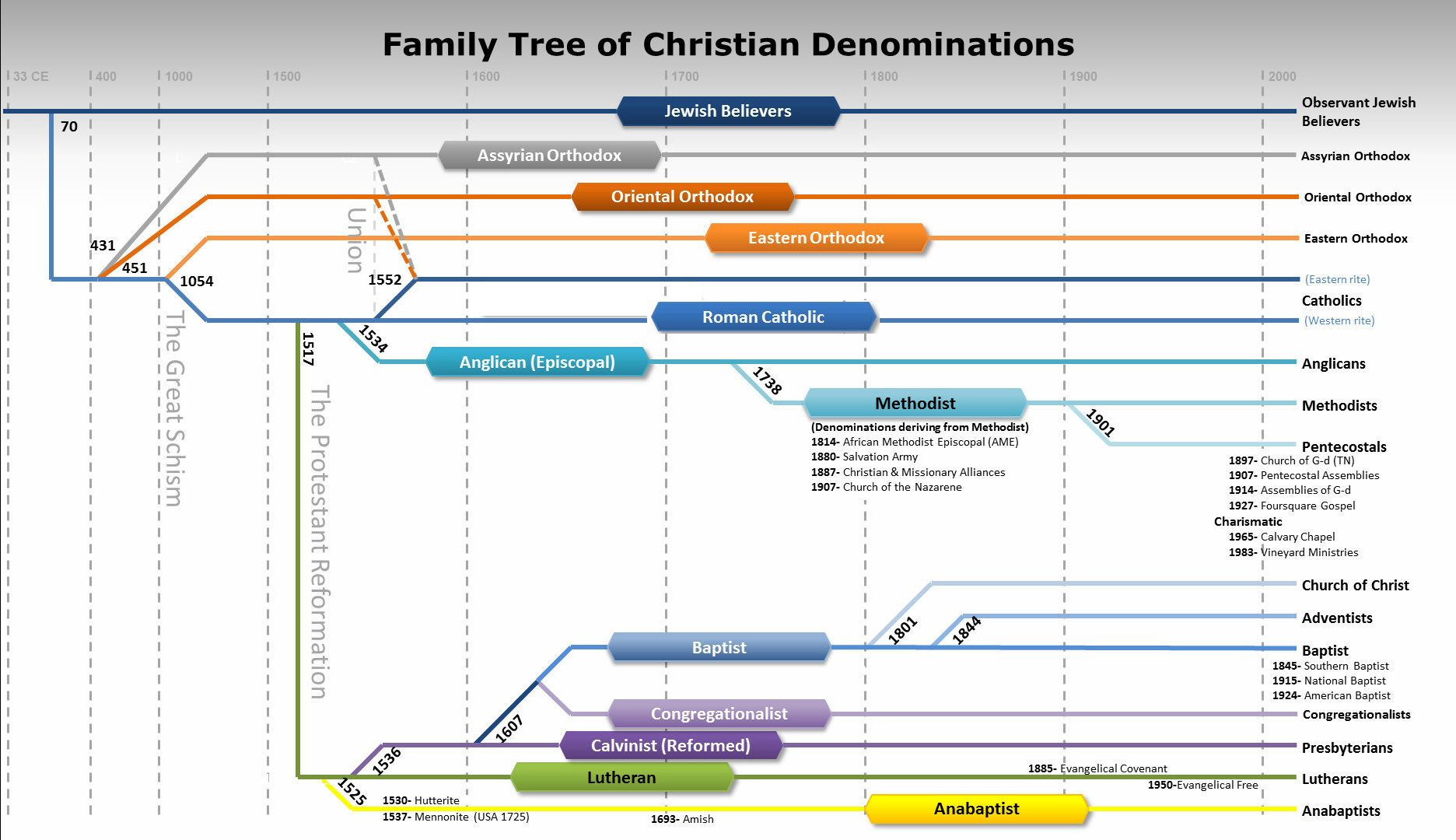
The fracturing of Christianity refers to the divisions that arose within the faith, particularly during the Great Schism of 1054, and the Protestant Reformation in the 16th century, which led to the establishment of various denominations and significant religious conflicts across Europe. These divisions were often fueled by differing interpretations of scripture, political influences, and the desire for reform within the church.
Many early Christians were merchants and others who had practical reasons for traveling to Asia Minor, Arabia, the Balkans, the Middle East, North Africa, and other regions. Over 40 such communities were established by the year 100, many in Anatolia, also known as Asia Minor, such as the Seven churches of Asia. By the end of the first century, Christianity had already spread to Rome, Ethiopia, Alexandria, Armenia, Greece, and Syria, serving as foundations for the expansive spread of Christianity, eventually throughout the world.
Causes of Division in Christianity
Key Factors
The fracturing of Christianity can be attributed to several key factors:
- Arrogance and Leadership Issues: Some leaders exhibit arrogance, refusing to acknowledge authority and creating divisions within congregations. This behavior can lead to a lack of accountability and a culture of exclusion.
- Divisive Speech: The use of harmful language, such as gossip and slander, can create rifts among church members. This type of communication undermines unity and fosters conflict.
- Exclusivity: Certain individuals may exclude others based on personal preferences or disagreements, treating the church as a private club rather than a welcoming community.
Historical Context
The history of Christianity shows that divisions often arise not from major scandals but from smaller, insidious issues that seep into church life. These can include:
- Theological Disagreements: Differences in interpretation of scripture can lead to significant splits within denominations.
- Cultural Conflicts: As society evolves, differing views on social issues can create tension among believers.
- Generational Gaps: Younger and older generations may have contrasting values and practices, leading to misunderstandings and divisions.
The Two Major Schisms
In Christianity, a schism occurs when a single religious body divides and becomes two separate religious bodies. The split can be violent or nonviolent but results in at least one of the two newly created bodies considering itself distinct from the other.
- The Great Schism – The Great Schism, also known as the East-West Schism, occurred in 1054 and marked the division between the Roman Catholic Church in the West and the Eastern Orthodox Church in the East. This split was primarily due to theological disagreements, political tensions, and differing views on church authority, particularly regarding the role of the Pope.
- The Protestant Reformation - The Protestant Reformation was a religious movement in the 16th century that led to the creation of Protestantism, challenging the practices and authority of the Roman Catholic Church. It began with Martin Luther's Ninety-Five Theses in 1517 and resulted in significant theological, political, and social changes across Europe.
Impact on the Church
The fracturing of Christianity affects not only individual congregations but also the broader Christian community. It can result in:
- Loss of Influence: Divisions can weaken the church's voice in society, making it less effective in addressing social issues.
- Decreased Membership: Ongoing conflicts may drive members away, leading to declining attendance and participation.
- Fragmentation of Beliefs: As groups splinter, the core tenets of Christianity may become diluted or misrepresented.
Understanding these factors is crucial for fostering unity and addressing the challenges facing the Christian community today.
Bible Translations
There are many different translations of the Bible, in many different languages, each with unique approaches to language and interpretation. Some popular English versions include the King James Version (KJV), New International Version (NIV), and English Standard Version (ESV), which vary in readability and accuracy to the original texts. For the purposes of this article, I have limited my overview to the major English Bible translations.
Overview of Bible Translations
The Bible has been translated into many versions, each with unique characteristics. Understanding these differences can help you choose the right one for your needs. The Berean Bible Portal is a website that can be easily utilized to search for the different translations of Bible verses.
Major Types of Bible Translations
Historical Translations
- King James Version (KVJ): The King James Version (KJV) bible, also known as the Authorized Version, is an English translation of the Christian Bible commissioned in 1604 and published in 1611. It includes 80 books, comprising 39 in the Old Testament, 27 in the New Testament, and 14 books of Apocrypha, although the Apocrypha is often omitted in modern editions.
Literal Translations
- English Standard Version (ESV): The English Standard Version (ESV) bible is a modern translation of the Bible that aims to be both accurate and readable, making it suitable for personal study, public worship, and memorization. It includes various study tools and resources to enhance understanding of the Scriptures.
- New American Standard Bible (NASB): The New American Standard Bible (NASB) bible is a modern English translation of the Bible, first published in 1971, known for its literal translation style that aims to closely reflect the original Hebrew, Aramaic, and Greek texts. It has undergone several revisions, with the most recent updates in 1995 and 2020, making it a popular choice for study and worship among many Christian communities..
Thought-for-Thought Translations
- New International Version (NIV): The New International Version (NIV) bible is a contemporary English translation of the Bible, first published in 1978, known for its balance of accuracy and readability. It was created by a team of over 100 scholars and is widely used in churches and personal study..
- New Living Translation (NLT): The New Living Translation (NLT) bible is a contemporary English translation of the Bible, first published in 1996. It aims to make the scriptures clear and accessible, using a dynamic equivalence approach to convey the meaning of the original texts in a way that is easy to understand.
Paraphrase Translations
- The Message (MSG): The Message (MSG) bible is a contemporary paraphrase of the Bible created by Eugene H. Peterson, designed to make the scriptures more accessible and relatable to modern readers. It emphasizes a conversational tone and aims to capture the original meaning of the texts in everyday language.
- The Living Bible (TLB): The Living Bible (TLB) bible is a paraphrase of the Bible created by Kenneth N. Taylor, first published in 1971. It aims to present the Scriptures in a clear and easy-to-understand manner, making it accessible for readers of all ages and backgrounds
Special Purpose Translations
Gender-Inclusive Translations
- New Revised Standard Version (NRSV): The New Revised Standard Version (NRSV) bible is a popular and respected translation of the Bible, first published in 1989. It aims to provide an accurate and modern English rendering of the scriptures, making it suitable for both scholarly study and personal reading.
Denominational Translations
- New World Translation (NWT): The New World Translation of the Holy Scriptures (NWT) bible is a Bible translation published by the Watch Tower Bible and Tract Society, primarily used by Jehovah's Witnesses. It was first released in 1950, with the complete Bible published in 1961, and is noted for its unique translation choices that some scholars criticize as biased.
Choosing the Right Bible
When selecting a Bible, consider your reading preferences and purpose. Some translations are better for study, while others are more suited for casual reading or devotional use. Each version offers a different approach to the original texts, so explore a few to find the one that resonates with you.